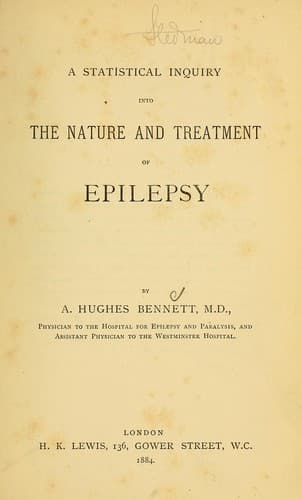
A Statistical Inquiry Into the Nature and Treatment of Epilepsy — John Shaqi
A Statistical Inquiry Into the Nature and Treatment of EpilepsyBennett, Alexander Hughes
Science
A Statistical Inquiry Into the Nature and Treatment of Epilepsy
Bennett, Alexander Hughes
Epilepsy
_Frequency of Attacks._--Only a general average of the number of attacks
can be made; and in the present series the following gives an idea of
the frequency of seizures in different individuals.
Average of one or more attacks per day in 8.8 per cent.
Average of one or more attacks per week in 31.1 per cent.
Average of one or more attacks per month in 32.2 per cent.
Average of one or more attacks per year in 15.5 per cent.
At longer or more irregular intervals in 12.2 per cent.
This roughly indicates that, in the majority of cases, attacks of
epilepsia gravior occur one or more times weekly or monthly. Under the
last series, of attacks taking place at longer and more irregular
intervals than a year, are included those cases where a few only have
occurred during the lifetime of the patients.
_Regularity of Attacks._--Many epileptics are attacked at regular
intervals, sometimes on the same day or even hour; while others are
afflicted at any time, day or night. The following indicate the
proportion:--
Attacks occur at regular intervals in 21.1 per cent.
Attacks occur at irregular intervals in 78.8 per cent.
_Time of Attack._--The following particulars alone could be definitely
ascertained:--
Attacks only during sleep in 8.8 per cent.
Attacks only during day while awake in 8.8 per cent.
Attacks only during early morning in 15.5 per cent.
Attacks at no particular time in 55.4 per cent.
The chief feature of this observation is that in 15.5 per cent. of cases
of E. Gravior the attacks always took place immediately after the
patients had wakened in the morning, and this is probably due to the
sudden alteration of the cerebral circulation from the sleeping to the
wakeful state.
_Symptoms immediately after the Attack._--The moment the attack is over
sometimes the patient is in his usual condition, and feels no ill
effects from the paroxysm. More commonly, however, he suffers from
various symptoms, the chief of which, and their relative frequency, is
as follows:--
Return to usual condition in 12.2 per cent.
Drowsy in 66.6 per cent.
Confused in 14.4 per cent.
Stupid in 13.3 per cent.
Irritable in 14.4 per cent.
Excitable in 3.3 per cent.
Vertigo in 13.3 per cent.
Headache in 41.1 per cent.
The above conditions may last from an hour to several days.
_Present condition, or state between the Attacks._--It is impossible to
enter minutely into the actual physical and mental health of all the
epileptic cases under notice, but the following statement gives a
sketch of some of the more important conditions associated with the
disease, and the frequency with which they occur. In the
inter-paroxysmal state the condition of the patients were--
Public-domain text, read in full here on John Shaqi.
Reviews
Reviews
No reviews yet
Be the first to share your thoughts on this work.
Join the Discussion
Join the discussion
Sign in to leave a comment or review.
Sign InorCreate an account