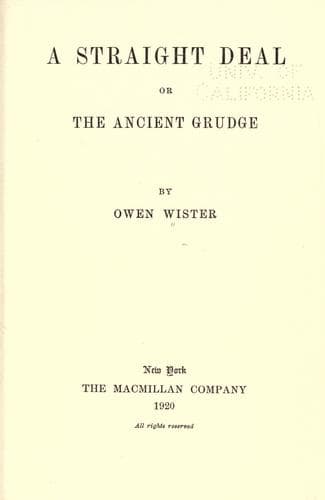
A Straight Deal; Or, The Ancient Grudge — John Shaqi
A Straight Deal; Or, The Ancient GrudgeWister, Owen
History
A Straight Deal; Or, The Ancient Grudge
Wister, Owen
Great Britain -- Relations -- United States; United States -- Relations -- Great Britain
Immediately after our Revolution, there was one of these heaps of
intrigue, in which we were concerned. This was at the time of the
negotiations leading to the Treaty of Paris, to which I made reference
at the close of the last section. This was in 1783. Twenty years later,
in 1803, occurred the heap of jackstraws that led to the Louisiana
Purchase. Twenty years later, in 1823, occurred the heap of jackstraws
from which emerged the Monroe Doctrine. Each of these dates, dotted
along through our early decades, marks a very important crisis in
our history. It is well that they should be grouped together, because
together they disclose, so to speak, a coherent pattern. This coherent
pattern is England’s attitude towards ourselves. It is to be perceived,
faintly yet distinctly, in 1783, and it grows clearer and ever more
clear until in 1898, in the game of jackstraws played when we declared
war upon Spain, the pattern is so clear that it could not be mistaken by
any one who was not willfully blinded by an anti-English complex. This
pattern represents a preference on England’s part for ourselves to other
nations. I do not ask you to think England’s reason for this preference
is that she has loved us so much; that she has loved others so much
less--there is her reason. She has loved herself better than anybody. So
must every nation. So does every nation.
Let me briefly speak of the first game of jackstraws, played at Paris
in 1783. Our Revolution was over. The terms of peace had to be drawn.
Franklin, Jay, Adams, and Laurens were our negotiators. The various
important points were acknowledgment of our independence, settlement
of boundaries, freedom of fishing in the neighborhood of the Canadian
coast. We had agreed to reach no settlement with England separately
from France and Spain. They were our recent friends. England, our recent
enemy, sent Richard Oswald as her peace commissioner. This private
gentleman had placed his fortune at our disposal during the war, and was
Franklin’s friend. Lord Shelburne wrote Franklin that if this was not
satisfactory, to say so, and name any one he preferred. But Oswald was
satisfactory; and David Hartley, another friend of Franklin’s and also
a sympathizer with our Revolution, was added; and in these circumstances
and by these men the Treaty was made. To France we broke our promise to
reach no separate agreement with England. We negotiated directly with
the British, and the Articles were signed without consultation with the
French Government. When Vergennes, the French Minister, saw the terms,
he remarked in disgust that England would seem to have bought a peace
rather than made one. By the treaty we got the Northwest Territory and
the basin of the Ohio River to the Mississippi. Our recent friend, the
French King, was much opposed to our having so much territory. It was
our recent enemy, England, who agreed that we should have it. This was
the result of that game of jackstraws.
Public-domain text, read in full here on John Shaqi.
Reviews
Reviews
No reviews yet
Be the first to share your thoughts on this work.
Join the Discussion
Join the discussion
Sign in to leave a comment or review.
Sign InorCreate an account