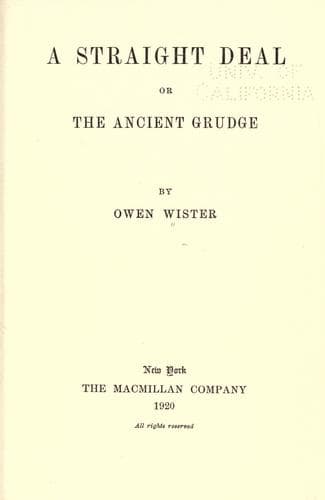
A Straight Deal; Or, The Ancient Grudge — John Shaqi
A Straight Deal; Or, The Ancient GrudgeWister, Owen
History
A Straight Deal; Or, The Ancient Grudge
Wister, Owen
Great Britain -- Relations -- United States; United States -- Relations -- Great Britain
Let us remember several things: in our Revolution, France had befriended
us, not because she loved us so much, but because she loved England so
little. In the Treaty of Paris, England stood with us, not because
she loved us so much, but because she loved France so little. We must
cherish no illusions. Every nation must love itself more than it loves
its neighbor. Nevertheless, in this pattern of England’s policy in 1783,
where she takes her stand with us and against other nations, there is a
deep significance. Our notions of law, our notions of life, our notions
of religion, our notions of liberty, our notions of what a man should be
and what a woman should be, are so much more akin to her notions than
to those of any other nation, that they draw her toward us rather
than toward any other nation. That is the lesson of the first game of
jackstraws.
Next comes 1803. Upon the Louisiana Purchase, I have already touched;
but not upon its diplomatic side. In those years the European game of
diplomacy was truly portentous. Bonaparte had appeared, and Bonaparte
was the storm centre. From the heap of jackstraws I shall lift out only
that which directly concerns us and our acquisition of that enormous
territory, then called Louisiana. Bonaparte had dreamed and planned
an empire over here. Certain vicissitudes disenchanted him. A plan to
invade England also helped to deflect his mind from establishing an
outpost of his empire upon our continent. For us he had no love. Our
principles were democratic, he was a colossal autocrat. He called us
“the reign of chatter,” and he would have liked dearly to put out
our light. Addington was then the British Prime Minister. Robert R.
Livingston was our minister in Paris. In the history of Henry Adams, in
Volume II at pages 52 and 53, you may find more concerning Bonaparte’s
dislike of the United States. You may also find that Talleyrand
expressed the view that socially and economically England and America
were one and indivisible. In Volume I of the same history, at page
439, you will see the mention which Pichon made to Talleyrand of the
overtures which England was incessantly making to us. At some time
during all this, rumor got abroad of Bonaparte’s projects regarding
Louisiana. In the second volume of Henry Adams, at pages 23 and 24, you
will find Addington remarking to our minister to Great Britain, Rufus
King, that it would not do to let Bonaparte establish himself in
Louisiana. Addington very plainly hints that Great Britain would back
us in any such event. This backing of us by Great Britain found very
cordial acceptance in the mind of Thomas Jefferson. A year before the
Louisiana Purchase was consummated, and when the threat of Bonaparte
was in the air, Thomas Jefferson wrote to Livingston, on April 18, 1802,
that “the day France takes possession of New Orleans, we must marry
ourselves to the British fleet and nation.” In one of his many memoranda
to Talleyrand, Livingston alludes to the British fleet.
Public-domain text, read in full here on John Shaqi.
Reviews
Reviews
No reviews yet
Be the first to share your thoughts on this work.
Join the Discussion
Join the discussion
Sign in to leave a comment or review.
Sign InorCreate an account