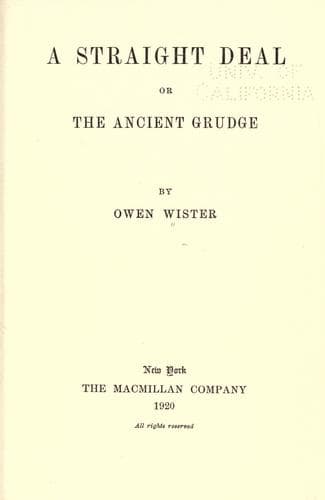
A Straight Deal; Or, The Ancient GrudgeWister, Owen
History
A Straight Deal; Or, The Ancient Grudge
Wister, Owen
Great Britain -- Relations -- United States; United States -- Relations -- Great Britain
Did you learn in school about “fifty-four forty, or fight”? We were
ready to take off our coat again. Or at least, that was the platform in
1844 on which President Polk was elected. At that time, what lay between
the north line of California and the south line of Alaska, which then
belonged to Russia, was called Oregon. We said it was ours. England
disputed this. Each nation based its title on discovery. It wasn’t
really far from an even claim. So Polk was elected, which apparently
meant war; his words were bellicose. We blustered rudely. Feeling ran
high in England; but she didn’t take off her coat. Her ambassador,
Pakenham, stiff at first, unbent later. Under sundry missionary
impulses, more Americans than British had recently settled along the
Columbia River and in the Willamette Valley. People from Missouri
followed. You may read of our impatient violence in Professor Dunning’s
book, The British Empire and the United States. Indeed, this volume
tells at length everything I am telling you briefly about these boundary
disputes. The settlers wished to be under our Government. Virtually upon
their preference the matter was finally adjusted. England met us with a
compromise, advantageous to us and reasonable for herself. Thus, again,
was her conduct moderate and pacific. If you think that this was through
fear of us, I can only leave you to our western blow-hards of 1845, or
to your anti-British complex. What I see in it, is another sign of that
fundamental sense of kinship, that persisting unwillingness to have
a real scrap with us, that stares plainly out of our whole first
century--the same feeling which prevented so many English from enlisting
against us in the Revolution that George III was obliged to get
Hessians.
Nicaragua comes next. There again they were quite angry with us on top,
but controlled in the end by the persisting disposition of kinship. They
had land in Nicaragua with the idea of an Isthmian Canal. This we did
not like. They thought we should mind our own business. But they agreed
with us in the Clayton-Bulwer Treaty that both should build and run the
canal. Vagueness about territory near by raised further trouble, and
there we were in the right. England yielded. The years went on and we
grew, until the time came when we decided that if there was to be any
canal, no one but ourselves should have it. We asked to be let off
the old treaty. England let us off, stipulating the canal should be
unfortified, and an “open door” to all. Our representative agreed to
this, much to our displeasure. Indeed, I do not think he should have
agreed to it. Did England hold us to it? All this happened in the
lifetime of many of us, and we know that she did not hold us to it. She
gave us what we asked, and she did so because she felt its justice, and
that it in no way menaced her with injury. All this began in 1850 and
ended, as we know, in the time of Roosevelt.
Public-domain text, read in full here on John Shaqi.
Reviews
Reviews
No reviews yet
Be the first to share your thoughts on this work.
Join the Discussion
Join the discussion
Sign in to leave a comment or review.
Sign InorCreate an account