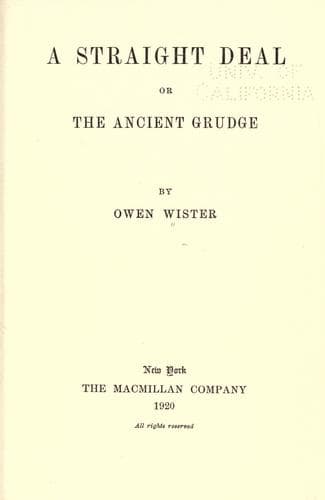
A Straight Deal; Or, The Ancient GrudgeWister, Owen
History
A Straight Deal; Or, The Ancient Grudge
Wister, Owen
Great Britain -- Relations -- United States; United States -- Relations -- Great Britain
About 1887 our seal-fishing in the Behring Sea brought on an acute
situation. Into the many and intricate details of this, I need not
go; you can find them in any good encyclopedia, and also in Harper’s
Magazine for April, 1891, and in other places. Our fishing clashed with
Canada’s. We assumed jurisdiction over the whole of the sea, which is a
third as big as the Mediterranean, on the quite fantastic ground that it
was an inland sea. Ignoring the law that nobody has jurisdiction outside
the three-mile limit from their shores, we seized Canadian vessels sixty
miles from land. In fact, we did virtually what we had gone to war with
England for doing in 1812. But England did not go to war. She asked for
arbitration. Throughout this, our tone was raw and indiscreet, while
hers was conspicuously the opposite; we had done an unwarrantable and
high-handed thing; our claim that Behring Sea was an “inclosed” sea was
abandoned; the arbitration went against us, and we paid damages for the
Canadian vessels.
In 1895, in the course of a century’s dispute over the boundary between
Venezuela and British Guiana, Venezuela took prisoner some British
subjects, and asked us to protect her from the consequences. Richard
Olney, Grover Cleveland’s Secretary of State, informed Lord Salisbury,
Prime Minister of England, that “in accordance with the Monroe Doctrine,
the United States must insist on arbitration”--that is, of the disputed
boundary. It was an abrupt extension of the Monroe Doctrine. It was
dictating to England the manner in which she should settle a difference
with another country. Salisbury declined. On December 17th Cleveland
announced to England that the Monroe Doctrine applied to every stage of
our national Life, and that as Great Britain had for many years refused
to submit the dispute to impartial arbitration, nothing remained to us
but to accept the situation. Moreover, if the disputed territory was
found to belong to Venezuela, it would be the duty of the United
States to resist, by every means in its power, the aggressions of Great
Britain. This was, in effect, an ultimatum. The stock market went to
pieces. In general American opinion, war was coming. The situation was
indeed grave. First, we owed the Monroe Doctrine’s very existence to
English backing. Second, the Doctrine itself had been a declaration
against autocracy in the shape of the Holy Alliance, and England was not
autocracy. Lastly, as a nation, Venezuela seldom conducted herself or
her government on the steady plan of democracy. England was exasperated.
And yet England yielded. It took a little time, but arbitration settled
it in the end--at about the same time that we flatly declined to
arbitrate our quarrel with Spain. History will not acquit us of
groundless meddling and arrogance in this matter, while England comes
out of it having again shown in the end both forbearance and good
manners. Before another Venezuelan incident in 1902, I take up a burning
dispute of 1903.
Public-domain text, read in full here on John Shaqi.
Reviews
Reviews
No reviews yet
Be the first to share your thoughts on this work.
Join the Discussion
Join the discussion
Sign in to leave a comment or review.
Sign InorCreate an account