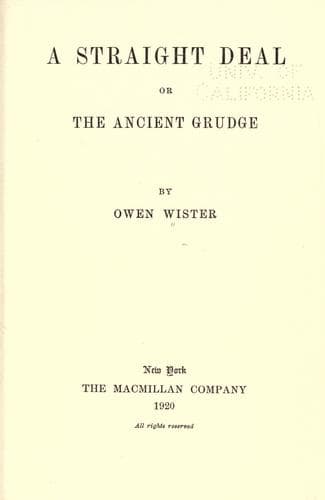
A Straight Deal; Or, The Ancient Grudge — John Shaqi
A Straight Deal; Or, The Ancient GrudgeWister, Owen
History
A Straight Deal; Or, The Ancient Grudge
Wister, Owen
Great Britain -- Relations -- United States; United States -- Relations -- Great Britain
That is the way to do these things: not by a peremptory public letter,
like Olney’s to Salisbury, which enrages a whole people and makes
temperate action doubly difficult, but thus, by a private letter to
the proper persons, very plain, very unmistakable, but which remains
private, a sufficient word to the wise, and not a red rag to the mob.
“To have the affair settled peacefully and with due regard to England’s
honor.” Thus Roosevelt. England desired no war with us this time, any
more than at the other time. The Commission went to work, and, after
investigating the facts, decided in our favor.
Our list of boundary episodes finished, I must touch upon the affair
with the Kaiser regarding Venezuela’s debts. She owed money to Germany,
Italy, and England. The Kaiser got the ear of the Tory government under
Salisbury, and between the three countries a secret pact was made
to repay themselves. Venezuela is not seldom reluctant to settle her
obligations, and she was slow upon this occasion. It was the Kaiser’s
chance--he had been trying it already at other points--to slide into a
foothold over here under the camouflage of collecting from Venezuela her
just debt to him. So with warships he and his allies established what he
called a pacific blockade on Venezuelan ports.
I must skip the comedy that now went on in Washington (you will find it
on pages 287-288 of Mr. Thayer’s John Hay, Volume II) and come at once
to Mr. Roosevelt’s final word to the Kaiser, that if there was not an
offer to arbitrate within forty-eight hours, Admiral Dewey would sail
for Venezuela. In thirty-six hours arbitration was agreed to. England
withdrew from her share in the secret pact. Had she wanted war with us,
her fleet and the Kaiser’s could have outmatched our own. She did not;
and the Kaiser had still very clearly and sorely in remembrance what
choice she had made between standing with him and standing with us a few
years before this, upon an occasion that was also connected with Admiral
Dewey. This I shall fully consider after summarizing those international
episodes of our Civil War wherein England was concerned.
Public-domain text, read in full here on John Shaqi.
Reviews
Reviews
No reviews yet
Be the first to share your thoughts on this work.
Join the Discussion
Join the discussion
Sign in to leave a comment or review.
Sign InorCreate an account