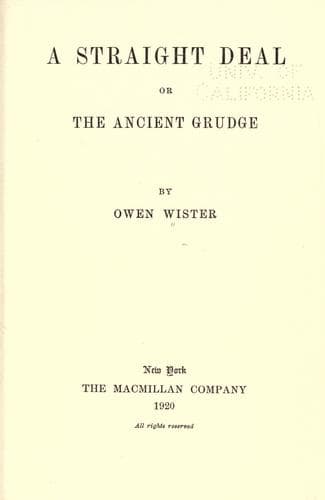
A Straight Deal; Or, The Ancient GrudgeWister, Owen
History
A Straight Deal; Or, The Ancient Grudge
Wister, Owen
Great Britain -- Relations -- United States; United States -- Relations -- Great Britain
As Oregon had formerly been, so Alaska had later become, a grave source
of friction between England and ourselves. Canada claimed boundaries in
Alaska which we disputed. This had smouldered along through a number of
years until the discovery of gold in the Klondike region fanned it to
a somewhat menacing flame. In this instance, history is as unlikely
to approve the conduct of the Canadians as to approve our bad manners
towards them upon many other occasions. The matter came to a head in
Roosevelt’s first administration. You will find it all in the Life of
John Hay by William R. Thayer, Volume II. A commission to settle
the matter had dawdled and failed. Roosevelt was tired of delays.
Commissioners again were appointed, three Americans, two Canadians,
and Alverstone, Lord Chief Justice, to represent England. To his friend
Justice Oliver Wendell Holmes, about to sail for an English holiday,
Roosevelt wrote a private letter privately to be shown to Mr. Balfour,
Mr. Chamberlain, and certain other Englishmen of mark. He said: “The
claim of the Canadians for access to deep water along any part of the
Alaskan coast is just exactly as indefensible as if they should now
suddenly claim the Island of Nantucket.” Canada had objected to our
Commissioners as being not “impartial jurists of repute.” As to this,
Roosevelt’s letter to Holmes ran on: “I believe that no three men in
the United States could be found who would be more anxious than our own
delegates to do justice to the British claim on all points where there
is even a color of right on the British side. But the objection raised
by certain British authorities to Lodge, Root, and Turner, especially
to Lodge and Root, was that they had committed themselves on the general
proposition. No man in public life in any position of prominence could
have possibly avoided committing himself on the proposition, any more
than Mr. Chamberlain could avoid committing himself on the ownership of
the Orkneys if some Scandinavian country suddenly claimed them. If this
embodied other points to which there was legitimate doubt, I believe Mr.
Chamberlain would act fairly and squarely in deciding the matter; but if
he appointed a commission to settle up all these questions, I certainly
should not expect him to appoint three men, if he could find them, who
believed that as to the Orkneys the question was an open one. I wish
to make one last effort to bring about an agreement through the
Com-mission.... But if there is a disagreement... I shall take a
position which will prevent any possibility of arbitration hereafter;...
will render it necessary for Congress to give me the authority to run
the line as we claim it, by our own people, without any further regard
to the attitude of England and Canada. If I paid attention to mere
abstract rights, that is the position I ought to take anyhow. I have
not taken it because I wish to exhaust every effort to have the affair
settled peacefully and with due regard to England’s honor.”
Public-domain text, read in full here on John Shaqi.
Reviews
Reviews
No reviews yet
Be the first to share your thoughts on this work.
Join the Discussion
Join the discussion
Sign in to leave a comment or review.
Sign InorCreate an account