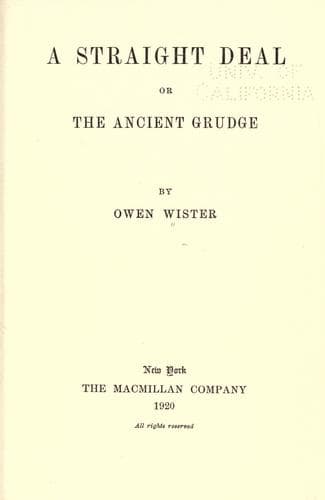
A Straight Deal; Or, The Ancient GrudgeWister, Owen
History
A Straight Deal; Or, The Ancient Grudge
Wister, Owen
Great Britain -- Relations -- United States; United States -- Relations -- Great Britain
England ran true to form. It is very interesting to mark this; very
interesting to watch in her government and her people the persistent and
conflicting currents of sympathy and antipathy boil up again, just as
they had boiled in 1776. It is equally interesting to watch our ancient
grudge at work, causing us to remember and hug all the ill will she
bore us, all the harm she did us, and to forget all the good. Roughly
comparing 1776 with 1861, it was once more the Tories, the aristocrats,
the Lord Norths, who hoped for our overthrow, while the people of
England, with certain liberal leaders in Parliament, stood our friends.
Just as Pitt and Burke had spoken for us in our Revolution, so Bright
and Cobden befriended us now. The parallel ceases when you come to the
Sovereign. Queen Victoria declined to support or recognize Slave Land.
She stopped the Government and aristocratic England from forcing
war upon us, she prevented the French Emperor, Napoleon III, from
recognizing the Southern Confederacy. We shall come to this in its turn.
Our Civil War set up in England a huge vibration, subjected England to
a searching test of herself. Nothing describes this better than a letter
of Henry Ward Beecher’s, written during the War, after his return from
addressing the people of England.
“My own feelings and judgment underwent a great change while I was in
England... I was chilled and shocked at the coldness towards the North
which I everywhere met, and the sympathetic prejudices in favor of
the South. And yet everybody was alike condemning slavery and praising
liberty!”
How could England do this, how with the same breath blow cold and hot,
how be against the North that was fighting the extension of slavery and
yet be against slavery too? Confusing at the time, it is clear to-day.
Imbedded in Lincoln’s first inaugural address lies the clew: he said,
“I have no purpose, directly or indirectly, to interfere with the
institution of slavery where it exists. I believe I have no lawful right
to do so, and I have no inclination to do so. Those who elected me
did so with full knowledge that I had made this and many similar
declarations, and had never recanted them.” Thus Lincoln, March 4, 1861.
Six weeks later, when we went-to war, we went, not “to interfere
with the institution of slavery,” but (again in Lincoln’s words) “to
preserve, protect, and defend” the Union. This was our slogan, this our
fight, this was repeated again and again by our soldiers and civilians,
by our public men and our private citizens. Can you see the position of
those Englishmen who condemned slavery and praised liberty? We ourselves
said we were not out to abolish slavery, we disclaimed any such object,
by our own words we cut the ground away from them.
Not until September 22d of 1862, to take effect upon January 1,
1863, did Lincoln proclaim emancipation--thus doing what he had said
twenty-two months before “I believe I have no lawful right to do.”
Public-domain text, read in full here on John Shaqi.
Reviews
Reviews
No reviews yet
Be the first to share your thoughts on this work.
Join the Discussion
Join the discussion
Sign in to leave a comment or review.
Sign InorCreate an account