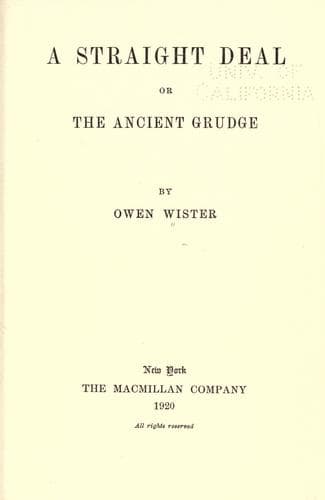
A Straight Deal; Or, The Ancient GrudgeWister, Owen
History
A Straight Deal; Or, The Ancient Grudge
Wister, Owen
Great Britain -- Relations -- United States; United States -- Relations -- Great Britain
That interim of anguish and meditation had cleared his sight. Slowly he
had felt his way, slowly he had come to perceive that the preservation
of the Union and the abolition of slavery were so tightly wrapped
together as to merge and be one and the same thing. But even had he
known this from the start, known that the North’s bottom cause, the
ending of slavery, rested on moral ground, and that moral ground
outweighs and must forever outweigh whatever of legal argument may be on
the other side, he could have done nothing. “I believe I have no lawful
right.” There were thousands in the North who also thus believed. It
was only an extremist minority who disregarded the Constitution’s
acquiescence in slavery and wanted emancipation proclaimed at once. Had
Lincoln proclaimed it, the North would have split in pieces, the South
would have won, the Union would have perished, and slavery would have
remained. Lincoln had to wait until the season of anguish and meditation
had unblinded thousands besides himself, and thus had placed behind him
enough of the North to struggle on to that saving of the Union and that
freeing of the slave which was consummated more than two years later by
Lee’s surrender to Grant at Appomattox.
But it was during that interim of anguish and meditation that England
did us most of the harm which our memories vaguely but violently
treasure. Until the Emancipation, we gave our English friends no public,
official grounds for their sympathy, and consequently their influence
over our English enemies was hampered. Instantly after January 1, 1863,
that sympathy became the deciding voice. Our enemies could no longer
say to it, “but Lincoln says himself that he doesn’t intend to abolish
slavery.”
Here are examples of what occurred: To William Lloyd Garrison, the
Abolitionist, an English sympathizer wrote that three thousand men of
Manchester had met there and adopted by acclamation an enthusiastic
message to Lincoln. These men said that they would rather remain
unemployed for twenty years than get cotton from the South at the
expense of the slave. A month later Cobden writes to Charles Sumner:
“I know nothing in my political experience so striking, an a display of
spontaneous public action, as that of the vast gathering at Exeter
Hall (in London), when, without one attraction in the form of a popular
orator, the vast building, its minor rooms and passages, and the streets
adjoining, were crowded with an enthusiastic audience. That meeting has
had a powerful effect on our newspapers and politicians. It has closed
the mouths of those who have been advocating the side of the South. And
I now write to assure you that any unfriendly act on the part of
our Government--no matter which of our aristocratic parties is in
power--towards your cause is not to be apprehended. If an attempt were
made by the Government in any way to commit us to the South, a spirit
would be instantly aroused which would drive that Government from
power.”
Public-domain text, read in full here on John Shaqi.
Reviews
Reviews
No reviews yet
Be the first to share your thoughts on this work.
Join the Discussion
Join the discussion
Sign in to leave a comment or review.
Sign InorCreate an account