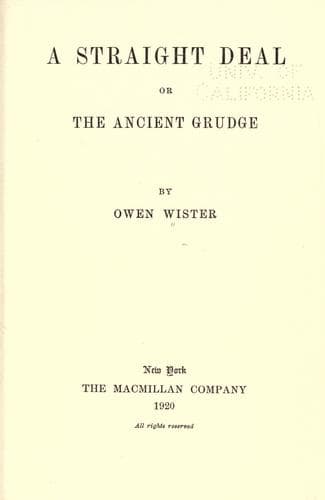
A Straight Deal; Or, The Ancient GrudgeWister, Owen
History
A Straight Deal; Or, The Ancient Grudge
Wister, Owen
Great Britain -- Relations -- United States; United States -- Relations -- Great Britain
“Some months ago... the question came to me, what about our Montgomery’s
History now.... I find that everywhere it is the King who is represented
as taking these measures against the American people. On page 134 is the
heading, American Commerce; the new King George III; how he interfered
with trade; page 135, The King proposes to tax the Colonies; page
136, ‘The best men in Parliament--such men as William Pitt and Edmund
Burke--took the side of the colonies.’ On page 138, ‘William Pitt said
in Parliament, “in my opinion, this kingdom has no right to lay a tax
on the colonies... I rejoice that America has resisted”’; page 150, ‘The
English people would not volunteer to fight the Americans and the King
had to hire nearly 30,000 Hessians to help do the work.... The Americans
had not sought separation; the King--not the English people--had forced
it on them....’
“I am writing this... because, as I was glad to see, you did not mince
words in naming several of the worse offenders.” (He means certain
school histories that I mentioned and shall mention later again.)
An official from Pittsburgh wrote thus:
“In common with many other people, I have had the same idea that England
was not doing all she could in the war, that while her colonies were in
the thick of it, she, herself, seemed to be sparing herself, but after
reading this article... I will frankly and candidly confess to you that
it has changed my opinion, made me a strong supporter of England, and
above all made me a better American.”
From Massachusetts:
“It is well to remind your readers of the errors--or worse--in American
school text books and to recount Britain’s achievements in the present
war. But of what practical avail are these things when a man so highly
placed as the present Secretary of the Navy asks a Boston audience
(Tremont Temple, October 30, 1918) to believe that it was the American
navy which made possible the transportation of over 2,000,000 Americans
to France without the loss of a single transport on the way over? Did
he not know that the greater part of those troops were not only
transported, but convoyed, by British vessels, largely withdrawn for
that purpose from such vital service as the supply of food to Britain’s
civil population?”
Public-domain text, read in full here on John Shaqi.
Reviews
Reviews
No reviews yet
Be the first to share your thoughts on this work.
Join the Discussion
Join the discussion
Sign in to leave a comment or review.
Sign InorCreate an account