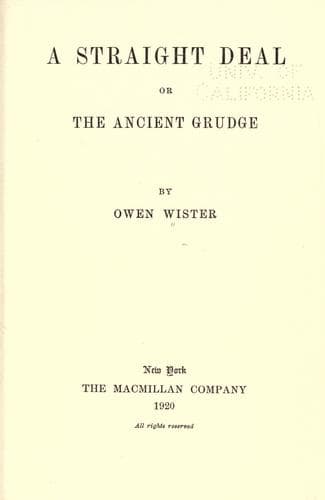
A Straight Deal; Or, The Ancient GrudgeWister, Owen
History
A Straight Deal; Or, The Ancient Grudge
Wister, Owen
Great Britain -- Relations -- United States; United States -- Relations -- Great Britain
The omission on the part of our Secretary of the Navy was later quietly
rectified by an official publication of the British Government, wherein
it appeared that some sixty per cent of our troops were transported in
British ships. Our Secretary’s regrettable slight to our British allies
was immediately set right by Admiral Sims, who forthwith, both in public
and in private, paid full and appreciative tribute to what had been
done. It is, nevertheless, very likely that some Americans will learn
here for the first time that more than half of our troops were not
transported by ourselves, and could not have been transported at all but
for British assistance. There are many persons who still believe what
our politicians and newspapers tell them. No incident that I shall
relate further on serves better to point the chief international moral
at which I am driving throughout these pages, and at which I have
already hinted: Never to generalize the character of a whole nation
by the acts of individual members of it. That is what everybody does,
ourselves, the English, the French, everybody. You can form no valid
opinion of any nation’s characteristics, not even your own, until
you have met hundreds of its people, men and women, and had ample
opportunity to observe and know them beneath the surface. Here on the
one hand we had our Secretary of the Navy. He gave our Navy the whole
credit for getting our soldiers overseas.
He justified the British opinion that we are a nation of braggarts.
On the other hand, in London, we had Admiral Sims, another American, a
splendid antidote. He corrected the Secretary’s brag. What is the moral?
Look out how you generalize. Since we entered the war that tribe of
English has increased who judge us with an open mind, discriminate
between us, draw close to a just appraisal of our qualities and defects,
and possibly even discern that those who fill our public positions are
mostly on a lower level than those who elect them.
I proceed with two more letters, both dissenting, and both giving
very typically, as it seems to me, the American feeling about
England--partially justified by instances mentioned by my correspondent,
but equally mentioned by me in passages which he seems to have skipped.
“Lately I read and did not admire your article... ‘The Ancient Grudge.’
Many of your statements are absolutely true, and I recognize the fact
that England’s help in this war has been invaluable. Let it go at that
and hush!
“I do not defend our own Indian policy.... Wounded and disabled in our
Indian wars... I know all about them and how indefensible they are.....
“England has been always our only legitimate enemy. 1776? Yes, call it
ancient history and forget it if possible. 1812? That may go in the
same category. But the causes of that misunderstanding were identically
repeated in 1914 and ‘15.
Public-domain text, read in full here on John Shaqi.
Reviews
Reviews
No reviews yet
Be the first to share your thoughts on this work.
Join the Discussion
Join the discussion
Sign in to leave a comment or review.
Sign InorCreate an account