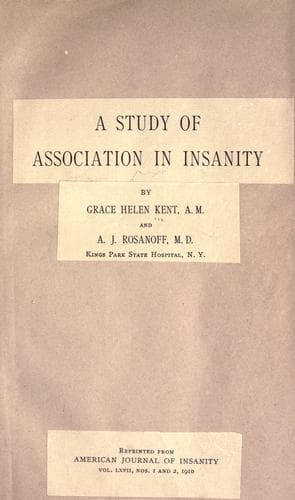
A Study of Association in InsanityKent, Grace Helen
Science
A Study of Association in Insanity
Kent, Grace Helen
Association of ideas; Psychology, Pathological
Dementia præcox 108 cases.
Paranoic conditions 33 "
Epilepsy 24 "
General Paresis 32 "
Manic-depressive insanity 32 "
Involuntary melancholia 8 "
Alcoholic psychoses 6 "
Senile dementia 4 "
A comparison of our pathological with our normal material _en
masse_ reveals in the former evidence of a weakening of the normal
tendency to respond by common reactions. This is shown in Table II.
TABLE II.
Common Doubtful Individual
reactions. reactions. reactions.
1,000 normal subject 91.7% 1.5% 6.8%
247 insane subjects 70.7% 2.5% 26.8%
It seems evident from this that pathological significance attaches
mainly to individual reactions, so that our study resolves itself
largely into (1) an analysis and classification of individual
reactions and (2) an attempt to determine what relationship, if any,
exists between the different types of reactions and the different
clinical forms of mental disease.
§ 2. CLASSIFICATION OF REACTIONS.
Those who have attempted to use the association test in the study of
insanity have felt the need of a practical classification of
reactions, and have at the same time encountered the difficulty of
establishing definite criteria for distinguishing the different groups
from one another. It is a comparatively simple matter to make these
distinctions in a general way and even to formulate a more or less
comprehensive theoretical classification, but there still remains much
difficulty in practice. We have made repeated attempts to utilize
various systems of classification which involve free play of personal
equation in their application. Although for us the matter is greatly
simplified by the elimination of all the common reactions with the aid
of the frequency tables, we have nevertheless met with no success. The
distinctions made by either of us have on no occasion fully satisfied,
at the second reading, either the one who made them or the other,
while a comparison of the distinctions made by each of us
independently has shown a disagreement to the extent of 20-35 per
cent.
Public-domain text, read in full here on John Shaqi.
Reviews
Reviews
No reviews yet
Be the first to share your thoughts on this work.
Join the Discussion
Join the discussion
Sign in to leave a comment or review.
Sign InorCreate an account