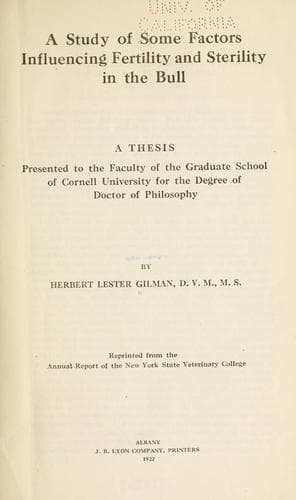
A study of some factors influencing fertility and sterility in the bullGilman, Herbert Lester
Science
A study of some factors influencing fertility and sterility in the bull
Gilman, Herbert Lester
Cattle; Infertility in animals; Livestock; Thesis (Ph. D.)
The interstitial tissue, besides conveying the blood vessels to the
organ, contains many “interstitial cells.” These cells are relatively
sparse in the adult bull, and are comparatively delicate, slightly
granular, often shuttle-shaped, with a rather small nucleus.
Embryologically they are derived from a syncitium arising from the
mesothelium of the genital ridge, differentiating out by growth of the
cytoplasm. They contain large quantities of fat, and elaborate the
internal secretion of the testis. This secretion governs the development
of the secondary sexual characters, and has a profound influence on the
general body metabolism, and development of the skeleton. The
interstitial cells appear early in embryonic life even before there is
any differentiation of sex, and their greater relative development in
the fetus is indicative of a future male development. In very young
embryos, the growth is very rapid, followed, however, by a period of
atrophy, during which the seminiferous tubules undergo marked
development. Pende (21) states: “There seems to be an inverse relation
between the growth of the tubular and interstitial tissues, as one is
hypoplastic when the other is in full activity.” From birth to the onset
of sexual maturity, which may be called a period of rest for the
testicle, the cells are few in number. With the accentuation of the
secondary sexual characters, and the beginning of sexual life, these
cells again increase in number and activity.
The parenchyma of the testis consists for the most part of the
seminiferous tubules, which, on account of the courses they take in the
different regions, are divided into groups. The peripheral tubules are
the much-contorted tubuli contorti. These anastomose to form the much
shorter tubuli recti. These in turn anastomose frequently, uniting to
form the rete testis. The rete proceeds through the mediastinum to form
the efferent ductules which break through the tunica albuginea to form
the greater part of the head of the epididymis. The tubuli contorti are
the longer and more numerous of the tubules, for it is here that
practically all the spermatozoa are produced. The straight tubules are
relatively so short that they may be regarded more in the light of the
beginning of the system of excretory ducts.
Public-domain text, read in full here on John Shaqi.
Reviews
Reviews
No reviews yet
Be the first to share your thoughts on this work.
Join the Discussion
Join the discussion
Sign in to leave a comment or review.
Sign InorCreate an account