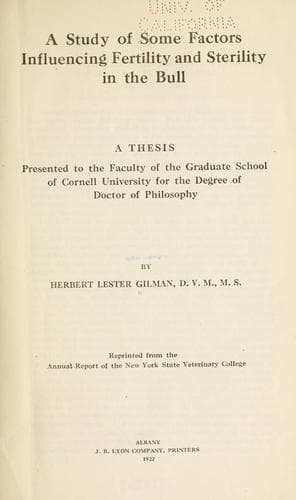
A study of some factors influencing fertility and sterility in the bullGilman, Herbert Lester
Science
A study of some factors influencing fertility and sterility in the bull
Gilman, Herbert Lester
Cattle; Infertility in animals; Livestock; Thesis (Ph. D.)
The _Male Reproductive Organs_ include the penis and testes, together
with the excretory passages which connect the testes with the urethral
canal. These excretory ducts include the epididymis, vas deferens, and
seminal vesicles. Posterior to their termination in the urethra, there
are connected the ducts of the prostate gland and the bulbo-urethral or
Cowper’s glands.
TESTES: The testicles of the bull are relatively large. Varying with the
size and age of the animal they measure from fourteen to seventeen
centimeters in length, including the epididymis, and from six to eight
centimeters in diameter. Each testicle is enclosed within a serous sac,
the tunica vaginalis, whose visceral layer is very intimately fused with
the underlying covering of the organ, the tunica albuginea. The tunica
albuginea is quite thin and consists of connective tissue which is rich
in elastic fibres. Muscular tissue is not present as it is in the case
of many mammals. Inside the tunica, and closely attached to, though
separated from, the parenchyma by a thin layer of connective tissue, is
a layer of very loose connective tissue, which because of its rich
supply of blood vessels is termed the tunica vasculosa. The parenchyma
is of a yellowish gray color, and of a rather soft consistency. It is
made up of the seminiferous tubules, rete, and the connective tissue
stroma, the mediastinum testis. On section, the mediastinum appears as
the center or axis of the entire organ. It is star-shaped, and radiates
connective tissue septa out into the parenchyma to support and separate
the tubules. Ellenberger states that the testis of the bull and all
ruminants lacks a closed system of interlobular septa, because of the
feeble development of the connective tissue.
The principal blood vessels and rete tubules are found in this
structure, the function of the latter being to connect the seminiferous
tubules and the efferent tubules of the epididymis. The epithelium of
the rete is quite irregular,—consisting in places of a single layer; in
others, of two layers. At some points there are formed groups of several
cells lying over one another, with swollen homogeneous basal cells,
which sometimes form projections into the lumen.
Public-domain text, read in full here on John Shaqi.
Reviews
Reviews
No reviews yet
Be the first to share your thoughts on this work.
Join the Discussion
Join the discussion
Sign in to leave a comment or review.
Sign InorCreate an account