A study of some factors influencing fertility and sterility in the bull — John Shaqi
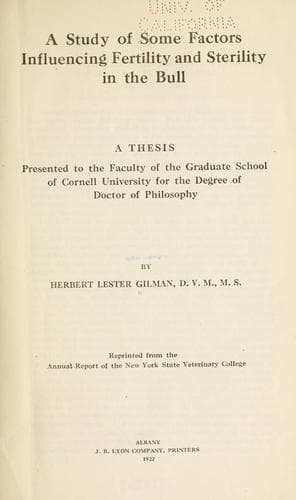
A study of some factors influencing fertility and sterility in the bullGilman, Herbert Lester
Science
A study of some factors influencing fertility and sterility in the bull
Gilman, Herbert Lester
Cattle; Infertility in animals; Livestock; Thesis (Ph. D.)
The VAS DEFERENS is quite narrow (2 mm.) and runs from the tail of the
epididymis to the verumontanum, or colliculus seminalis, where it
empties into the urethra in common with the duct of the vesicle. At
first it is lined by epithelium similar to that of the vas epididymis,
but this changes over into a peculiar low stratified type. Ellenberger
describes it as follows: “The epithelium shows a very pronounced basal
coat. The overlying cell zone shows more (at the most, three) rows lying
over each other of elongated nuclei, while an outline of cell form is
not ordinarily noticeable, so that it may be spoken of as a syncitium,
and at the same time as a many layered epithelium.” The mucosa forms
low, broad folds into the lumen. The tunica propria is a thin connective
tissue layer. The submucosa consists of thin connective tissue. Three
muscular coats are present: an inner thin longitudinal layer, middle
circular layer, and an outer longitudinal layer. All are more or less
intimately blended, and are surrounded by the adventitia, made up of
connective tissue, elastic fibres and scattered longitudinal muscle
cells of the internal cremaster muscle. Near the dorsal surface of the
bladder, the ducts come in close apposition, and for ten to twelve
centimeters dilate to form the ampullae. Here the mucous membrane
becomes much plicated, forming long folds which anastomose freely. The
function of the vas is to convey the spermatozoa and secretions from the
epididymis to the urethra. Disselhorst (26) believes the ampulla acts as
a seminal reservoir and states that he has found spermatozoa stored up
in the little pockets in the walls of this structure in animals during
the rutting time. He suggests, further, that there is a relation between
the state of development of the ampulla and the time occupied by
copulation. When the organ is small or absent, as in dogs, cats, and
boars, the coition is a slow process, but when the ampulla is large and
well developed, as in horses and sheep, the coitus requires a relatively
short time. Inasmuch as coitus is so rapid in the bull, and the ampulla
is so well developed, it seems as though this function is very probable.
Public-domain text, read in full here on John Shaqi.
Reviews
Reviews
No reviews yet
Be the first to share your thoughts on this work.
Join the Discussion
Join the discussion
Sign in to leave a comment or review.
Sign InorCreate an account