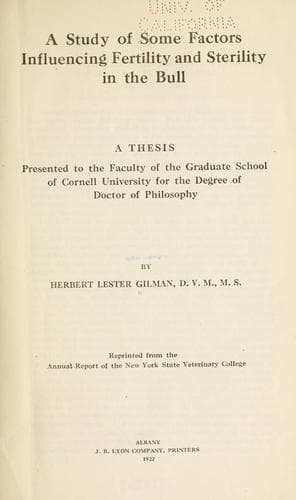
A study of some factors influencing fertility and sterility in the bull — John Shaqi
A study of some factors influencing fertility and sterility in the bullGilman, Herbert Lester
Science
A study of some factors influencing fertility and sterility in the bull
Gilman, Herbert Lester
Cattle; Infertility in animals; Livestock; Thesis (Ph. D.)
The SEMINAL VESICLES are very compact glandular structures lying on
either side of the median line, on the dorsal side of the bladder, and
ventral to the rectum. In the mature bull they measure ten to twelve
centimeters in length, four centimeters in width, and about two and
one-half to three centimeters in thickness. The glands are distinctly
lobulated, quite tortuous, and are often asymmetrical in size and shape.
They converge posteriorly, to empty into the urethra at the colliculus
seminalis with the ampulla, in a slightly oval slit in the mucosa.
Microscopically, the gland is of the anastomosing tubular type, with
very poorly developed excretory ducts to the glandular cavities.
Posteriorly one finds centrally a few sinus-like narrow excretory
passages, which open into the somewhat larger collecting and excretory
duct. The epithelium is of the simple columnar type and produces a
relatively large amount of secretion. The gland cavities are surrounded
by a membrana propria, over which is a relatively thick layer of smooth
muscle. Outside this is a connective tissue covering which sends
trabeculae or septa in between the lobules. The secretion of the seminal
vesicles is a tenacious albuminous fluid with a slightly yellowish
tinge, all or part of which appears in the ejaculate in the form of
swollen sago-like grains which are soon dissolved following ejaculation
and the liquefaction of the semen. The proteid compounds belong to the
group of histones. The secretion is liquid when warm and coagulates when
cold. Some say that the filling of the vesicles serves to excite sexual
feeling, but this is doubtful in view of the fact that in some animals
the sexual desire exists before the vesicles are filled. Likewise,
Steinach found that rats, whose seminal vesicles had been removed, still
retained their desire for copulation. The function of the secretion is
to furnish much of the volume to the semen, and in some way it has a
distinct bearing on fertility, inasmuch as extirpation of the organs in
rats leads to lowered fertility. The vesicles of the bull are in no
sense a store-house for spermatozoa, as is usually understood. Repeated
examinations in a large number of bulls have led to the finding of
spermatozoa there only in very rare instances. That they serve as a
resorption place for sperms that are not ejaculated is also very
unlikely. Normally, one sees on smear of the vesicles, occasional cells,
leucocytes, lecithin granules, sago bodies, and rarely a few degenerated
spermatozoa.
Public-domain text, read in full here on John Shaqi.
Reviews
Reviews
No reviews yet
Be the first to share your thoughts on this work.
Join the Discussion
Join the discussion
Sign in to leave a comment or review.
Sign InorCreate an account