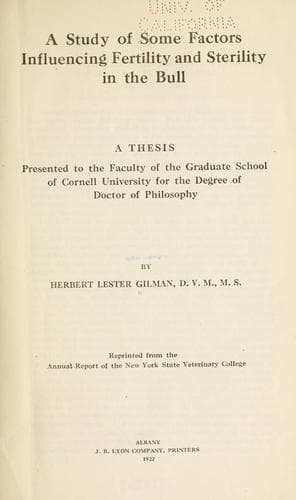
A study of some factors influencing fertility and sterility in the bullGilman, Herbert Lester
Science
A study of some factors influencing fertility and sterility in the bull
Gilman, Herbert Lester
Cattle; Infertility in animals; Livestock; Thesis (Ph. D.)
SEMEN: The semen is the mixed product of the testicles, their excretory
passages, and the accessory sexual glands, a fact which complicates its
study considerably. The freshly ejaculated fluid is cloudy, tenacious,
more or less coagulable, and is rich in albumen. It is weakly alkaline
in reaction, and contains eighty to ninety per cent of water. Of the
solid constituents, there is forty per cent of ash, of which
three-fourths is calcium phosphate. Besides the spermatozoa, the semen
frequently contains epithelial cells, leucocytes, concentric amyloid
concretions, and lecithin bodies. When cold, the characteristic
phosphoric acid salts are precipitated. The fluid content is the product
of the tubules of the testicles, their excretory ducts, and the
accessory sexual glands. The characteristic odor of the semen is
supplied by a slimy nucleoalbumen “spermin” which forms the spermatic
crystals, and is furnished by the prostatic secretion.
During ejaculation the spermatozoa and secretions added by the testicle
and epididymis are probably carried to the ampulla by peristaltic
muscular action, in the earlier stages of the orgasm. At the height of
the orgasm, the ampulla is emptied into the posterior urethra in common
with the secretion of the contracting vesicles, here to be admixed with
the thin prostatic secretion. The entire mixture is then propelled, and
ejaculation produced by strong muscular contractions of the entire
urethra. As was stated before, the semen is the product of the
testicles, the excretory ducts, and the accessory sexual glands. The
testes furnish the essential germinal elements, the sperms, and some of
the fluid content. Then is added the product of the epididymis, vas, and
ampulla, which stimulates the spermatozoa to active motility, nourishes
the organisms, and adds somewhat to the fluid bulk of the secretion.
Stigler (25) states: “During its sojourn in the epididymis, the
properties of the spermatozoa are modified; the motility, ability to
resist heat, and other properties are augmented, at least in the case of
the guinea pig, rat, and mouse.” To the secretion is then added the
product of the vesicles, which contributes markedly to its fluid
content, nourishes the sperms, and supplies the ferment which induces
clotting of the semen when ejaculated. This is very important because
the clot formed in the vagina protects the delicate spermatozoa from the
hostile acid vaginal secretion. The prostate likewise adds bulk and
nourishing substances, besides stimulating the spermatozoa to fuller and
more lasting motility. The addition of the spermin is perhaps
unimportant. The function of the secretion of the Cowper’s glands, which
is added at this time, is problematical. It does, however, have a
diluting action on the semen. Perhaps its secretion is poured out prior
to ejaculation so as to lubricate the canal and prepare the way for the
semen.
Public-domain text, read in full here on John Shaqi.
Reviews
Reviews
No reviews yet
Be the first to share your thoughts on this work.
Join the Discussion
Join the discussion
Sign in to leave a comment or review.
Sign InorCreate an account