A study of some factors influencing fertility and sterility in the bull — John Shaqi
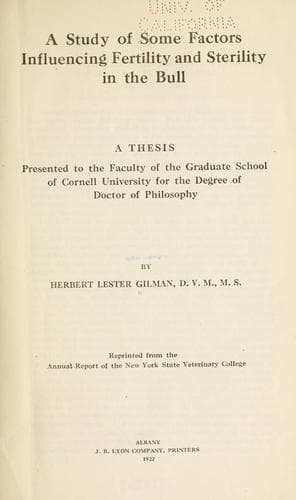
A study of some factors influencing fertility and sterility in the bullGilman, Herbert Lester
Science
A study of some factors influencing fertility and sterility in the bull
Gilman, Herbert Lester
Cattle; Infertility in animals; Livestock; Thesis (Ph. D.)
Fish (28) has demonstrated by means of darkfield illumination, the
presence of numerous minute particles or ultraparticles in this fluid.
Their character and significance are matters of conjecture, but it would
seem as though they were not identical with the “chylomicrons” or fat
particles found in the blood by Gage. Perhaps further researches will
reveal some intimate connection between the number present in a field,
and the relative potency of the animal.
Each portion of the tract furnishes some essential element to the mixed
product which is so remarkably adapted both as a vehicle for the
ejaculation of the spermatozoa, and as a fluid in which their motility
is initiated and maintained. Any derangement of one part is fraught with
danger to the existence of viable spermatozoa, and the continuation of
full fertility on the part of the animal. The physiology of each
contributing gland must be borne in mind at all times. Walker (31)
investigated the fertility of the semen of the dog, taken from various
parts of the tract. His results were: (1) semen from the testicle and
head of the epididymis showed no motility, (2) semen from the tail of
the epididymis showed some motility in the more fluid contents of the
preparations, (3) semen from the vas deferens appeared about the same,
(4) a mixture of epididymis semen and prostatic secretion showed active
motility, and (5) likewise in a mixture of epididymis semen, though only
in those places where the fluids had become well mixed. My observations,
however, differ in one respect with regard to the bull, as I have found
full motility of the spermatozoa from the epididymis, but it is not so
lasting as when augmented by the addition of the prostatic fluid.
Boettcher (32) concludes: “that the secretion of the accessory male
genital organs possesses a protective colloid, which (1) hinders the
spermatozoid action of the vaginal secretion, at least until the sperms
have time to reach the interior of the uterus which is an alkaline
reaction, (2) that it makes the ejaculate more voluminous, so that by
cohabitation, a very good part of the vagina becomes moistened, and the
spermatozoa become distributed over the greater part of the vaginal
mucosa. This distribution is rendered necessary because some of the
fluid flows from the vagina following coitus. In this manner the
opportunity is given for a part of the ejaculate containing the
spermatozoa to be brought easier to the external os, and (3) it happens
that because of its content of sodium chloride the life of the
spermatozoa is stimulated and prolonged.” A fuller discussion of the
essential physiology of the various parts of the tract on the semen
content, and fertility, will be taken up later. The changes in
biochemical content, reaction, and the result of the addition of
bacterial products will also be more fully discussed.
Public-domain text, read in full here on John Shaqi.
Reviews
Reviews
No reviews yet
Be the first to share your thoughts on this work.
Join the Discussion
Join the discussion
Sign in to leave a comment or review.
Sign InorCreate an account