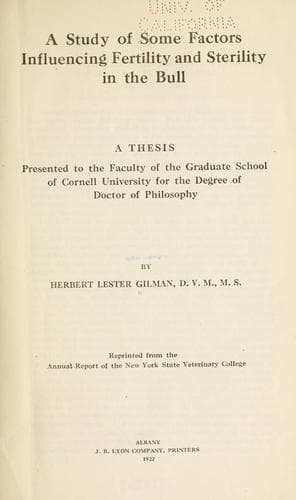
A study of some factors influencing fertility and sterility in the bullGilman, Herbert Lester
Science
A study of some factors influencing fertility and sterility in the bull
Gilman, Herbert Lester
Cattle; Infertility in animals; Livestock; Thesis (Ph. D.)
“The third type of normal motion succeeds the second and consists in a
tendency on the part of the spermatozoon to push itself against or into
any small masses of cells, or sometimes other materials, which it may
find in the neighborhood, bunting itself into any small cove that can be
found, and maintaining a slight burrowing motion by a lashing tail
movement of the vibratile type not unlike the movements of the caudal
fin of a fish. The movement of the flagellum in this third type is
unlike the second type in that it is vibratile rather than lashing, but
is slower than the vibratile motion of the first type and less limited
to the afterpart of the tail. These spermatozoa are apparently not
caught in the debris or unable to move off. From time to time, they back
out of such a cove and seek another mooring place.
“This ‘stationary hunting’ motion is less universal than the other two.
Many individual spermatozoa fail to attain it. It seems probable that
only the most vigorous individuals ever reach this stair”. It has not
been encountered in unmixed semen or in any artificial mediums. It has
been observed only when the spermatozoon is in the secretions of the
female genital tract. It is most frequent when the spermatozoon is in
contact with a nest of epithelial cells....
“The three types of normal motion are not only distinctive but are
always consecutive, i. e., the second follows the first after a period
which is apparently determined both by initial vitality and by the
favorable or unfavorable character of the medium, while the third has
been observed to occur only in individuals which have already developed
the second. They apparently constitute a normal cycle.
“This cycle is open to the theoretical explanation that these types of
motion are directly adapted to the function of the spermatozoon; thus,
the progressive vibratile motion which is characteristic of the earliest
period of its existence appears especially suitable for its prolonged
journey through the cervix and uterus to the fundus and tube. This is
supported by the fact that during this motion it always heads directly
against any existing current, and that during this stage of its journey
it must under natural conditions be continuously exposed to the faint
outward ciliary currents of the mucous membrane of these passages.
“The undulatory tactile motion which succeeds the progressive vibratile
would then be well adapted to the later stage in which the spermatozoon
has reached the tube, where its success in conjugation is dependent on
its finding the ovum rather than on further progress.
Public-domain text, read in full here on John Shaqi.
Reviews
Reviews
No reviews yet
Be the first to share your thoughts on this work.
Join the Discussion
Join the discussion
Sign in to leave a comment or review.
Sign InorCreate an account