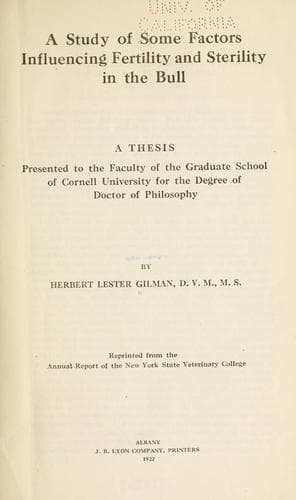
A study of some factors influencing fertility and sterility in the bullGilman, Herbert Lester
Science
A study of some factors influencing fertility and sterility in the bull
Gilman, Herbert Lester
Cattle; Infertility in animals; Livestock; Thesis (Ph. D.)
“The stationary bunting type of motion is that which would be demanded
by the passage of the spermatozoon through the egg membrane which has
been so often observed in the lower animals. This very plausible
explanation is, however, necessarily theoretical and must always remain
so, as the conditions which surround the specimen on the field of the
microscope vary in so many respects from those in which it accomplishes
conjugation in the course of nature; but the practical importance of the
study of types of motion is not affected by their explanation.”
The duration of motility is a variable factor, dependent entirely upon
the environment in which the spermatozoa are placed. Within the body
they usually survive at least a week. One author describes a case in
which he found living sperms in a woman who stated that coition had not
been experienced for three and one-half weeks. It has been stated with
regard to human sperms, that their motion should continue or be capable
of being re-established for twelve hours. Cary (35) states, “first, that
in their proper medium and at the body temperature the viability of the
sperm cells may extend over a period of a few days; second, that their
prolonged vitality is probably dependent upon the normal lime salts of
the prostatic fluid; third, that the sustaining power of the seminal
fluid is increased by its union with the normal secretion of the female
genital tract.” After death of the male animal they retain their
motility in the genital tract for twenty-four to forty-eight hours.
Wolf (36) worked on this problem in rabbits, and summarizes as follows:
“The motility of rabbit spermatozoa can be preserved for at least nine
days by placing the juice of the epididymis in the Tyrode solution which
had been buffered and to which glucose had been added. The solution is
adjusted to a pH of about 7.4. Oxygen is passed in and a suitable amount
of sodium bicarbonate added. The preparation must be kept at a
temperature near the freezing point of water.” Under ordinary conditions
motility persists outside the body only a few hours after ejaculation,
but if the semen is kept quite cool till the time of examination on a
warm stage, motility should be capable of being restored in at least a
fair percentage of the sperms for twenty-four to forty-eight hours. The
cells are more sensitive to heat than to cold, and even to dilute acids
more than to alkalies.
Public-domain text, read in full here on John Shaqi.
Reviews
Reviews
No reviews yet
Be the first to share your thoughts on this work.
Join the Discussion
Join the discussion
Sign in to leave a comment or review.
Sign InorCreate an account