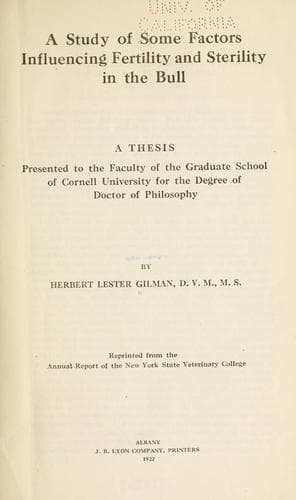
A study of some factors influencing fertility and sterility in the bull — John Shaqi
A study of some factors influencing fertility and sterility in the bullGilman, Herbert Lester
Science
A study of some factors influencing fertility and sterility in the bull
Gilman, Herbert Lester
Cattle; Infertility in animals; Livestock; Thesis (Ph. D.)
With a hypersecretion of one or all of the glands, the semen becomes
quite thin and watery, with a deficiency of solid matter, together with
changes in reaction. On the other hand, hypofunction results in a
secretion too viscid, which is equally unsuited to the requirements of
the spermatozoa. The thin watery semen clots imperfectly or not at all,
and clotting is essential in protecting the spermatozoa from the acid
secretions of the vagina. Likewise, a medium too viscid is a distinct
hindrance to motility. Changes in reaction are very frequently
encountered. The sperms are very sensitive to dilute acids, so that with
even a slight acidity motility may diminish or entirely cease. Purulent
inflammatory exudates are occasionally mixed with the semen, and
although the pus cells themselves have not been found to be destructive
to the sperms, certain degeneration products in the exudate are very
toxic, and inhibit or destroy the motility. So far, I have failed to
find red corpuscles present. One very interesting sample of semen was
quite thick, of a yellowish green color, and of a distinctly acid
reaction. The secretion from the vesicles was later found to be of this
same character, and was due to a _Ps. pyocyaneus_ infection. The
vesicles were highly inflamed and degenerated. The spermatozoa were in
this case markedly decreased in number, and devoid of motility.
The early precipitation of the “Boettcherchen” crystals seems to be
intimately connected with sterile semen, or spermatozoa of lowered
vitality. Likewise, a decrease in solid matter is often seen in a
deficient secretion. In normal semen, the clot disappears after standing
a time, and a thick sediment settles out. This sediment is decreased in
amount as a rule in abnormal semen.
SPERMATOZOA: Spermatozoa, the essential germinal elements, are very
frequently abnormal, changes in which may be manifested in many ways. We
may divide the deviations into changes in structure, and changes in the
motility which is so indicative of the intrinsic vitality of the sperm.
Reynolds (34) describes two forms of abnormal motion. The first is
“rotary swimming,” in which the sperms move forward progressively, and
sometimes with fair rapidity, but in a spiral screwlike manner. He
states that this type of swimming is very awkward, easy to recognize,
and is usually of quite long duration. The other form termed “pendulum
swimming,” he states, is less common than the rotary swimming and is
usually confined to relatively fewer sperms in a given field. “In this
the middle piece and upper tail seem to lose their flexibility and
balance to a considerable degree, and the lower tail motion swings the
forward part of the spermatozoon to and fro with a pendulum movement.
This type of swimming yields very poor progress.”
Public-domain text, read in full here on John Shaqi.
Reviews
Reviews
No reviews yet
Be the first to share your thoughts on this work.
Join the Discussion
Join the discussion
Sign in to leave a comment or review.
Sign InorCreate an account