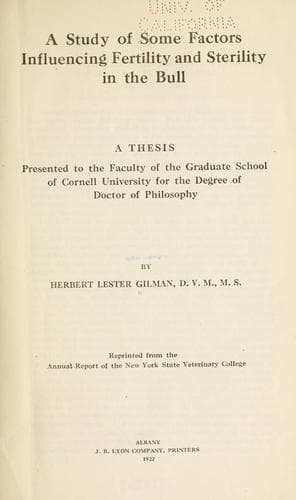
A study of some factors influencing fertility and sterility in the bull — John Shaqi
A study of some factors influencing fertility and sterility in the bullGilman, Herbert Lester
Science
A study of some factors influencing fertility and sterility in the bull
Gilman, Herbert Lester
Cattle; Infertility in animals; Livestock; Thesis (Ph. D.)
One factor we must bear in mind in the study of the semen obtained from
the vagina, is that the spermatozoa may be highly motile before
ejaculation, but the admixture of hostile vaginal mucus may inhibit or
destroy the motility. On the other hand, the conditions may be reversed.
Cary (35), in one instance, found that the spermatozoa in a sample of
semen collected from a condom, appeared to be of very low vitality,
while when they were mixed with the vaginal secretions, an exaggerated
activity was manifested. May we not have to contend with this factor in
some herds in which there is a very distinct acid and toxic vaginal
secretion from the products of cervicitis and vaginitis?
In a study of motility, we must consider not only the abnormal types
which may be encountered but the percentage of motile cells, and the
duration of the movement. In _necrospermia_ all the ejaculated cells are
motionless or dead. In other specimens, varying percentages of the cells
are without motion, and the others may be possessed of full and lasting
motility. On the other hand, the motility in some cases is very active
at first, but quickly subsides even under the best of conditions. The
appearance in freshly ejaculated semen of numerous sperms that have a
tendency to take on the “undulatory tactile” type of motion when they
should be in a highly active state, is very indicative of lowered
vitality. Many specimens present this very picture, whereas the very
active progressive movement should, under proper conditions, survive for
a considerable time before it gives way to the second, and slower type.
The cells frequently early bunt into epithelial cells or clumps of
immotile sperms, then back out and move around sluggishly, only to
repeat the same performance till they stop moving entirely. I have seen
one specimen in which the sperms all tended to clump. Whether this was
the result of some agglutinative substance in the vaginal secretion is
problematical. I have seen several specimens of semen in which
practically all the sperms were motile when first examined, but the
motion did not survive for any great length of time. Even a small
percentage of motionless sperms or of those showing lowered vitality is
a considerable factor in potency. Although millions of the germinal
elements are ejaculated into the vagina, large numbers of them are
destroyed or become motionless there, and a small number is left behind
in the cervix and uterus; so that even though but a single sperm is
required for fertilization, the chances of impregnation are diminished
in proportion to the number of dead or defective sperms.
Public-domain text, read in full here on John Shaqi.
Reviews
Reviews
No reviews yet
Be the first to share your thoughts on this work.
Join the Discussion
Join the discussion
Sign in to leave a comment or review.
Sign InorCreate an account