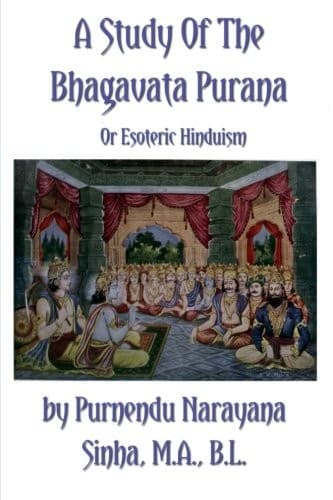
A Study of the Bhâgavata Purâna; or, Esoteric Hinduism
Religion
A Study of the Bhâgavata Purâna; or, Esoteric Hinduism
Puranas. Bhagavatapurana. English
V = Vayu cover 1000 or 50.000 Krores Yojanas.
T’ = Tejas cover 100 or 5000 Krores Yojanas.
A = Âpas cover 10 or 500 Krores Yojanas.
E = Earth cover 1 or 50 Krores Yojanas.
S’= Satya Loka
T = Tapas Loka
J = Jana Loka
M = Mahar Loka
S = Svar Loka
B’ = Bhuvar Loka
B = Bhûr Loka
P = Seven Pâtâlas
S’ to P = 50 Krores Yojanas.
A’ to E = Includes Tanmatras, Indriyas and Prana.
Prakriti surrounds the whole circle.
WHAT MEN ARE TO DO AND WHAT THEY ARE NOT TO DO.
*SKANDHA II. CHAP. 3.*
This was the second part of Parikshit’s question, and to this general
question, the answer is also general. Those that want divine glory
worship Brahmâ. Those that want their Indriyas to be powerful worship
Indra and so on. But those that are desirous of Moksha must practise
Bhakti Yoga towards the supreme Purusha. Of all Upasakas, this is the
only means of attaining supreme bliss, unswerving Bhakti or devotion to
Bhagavân and the company of Bhâgavatas.
THE BHAGÂVATA PURÂNA AS RELATED BY BRAHMÂ TO NÂRADA.
*SKANDHA II. CHAP. 4-6.*
I. THE CREATION.
Parikshit next asked "How did Bhagavân create this Universe, how does He
preserve it, how will He draw it in? What are the Śaktis by which He
manifests Himself directly and indirectly? What are His actions?"
Suka replied, these were the very questions asked by Nârada of his
father Brahmâ.
Brahmâ replied: — "Wishing to become manifold, the Lord of Mâyâ,
influenced Kala, Karma and Svabhâva, by his own Mâyâ". (Kala is the flow
of Time and is, according to the Bhâgavata Purâna, the Śakti of Purusha.
Karma is the _adrishta_ of Jiva or the Jiva record of the previous
Kalpa. Svabhâva is the essence of Prakriti). Under the influence of
Purusha, the first disturbance in the equilibrium of the Gunas follows
from Kala, transformation follows from Svabhâva and the development of
Mahat Tatva follows from Karma. When Rajas and Tamas manifest themselves
in Mahat Tatva, it is transformed into Ahankâra Tatva, with predominant
Tamas. Ahankâra Tatva by transformation becomes threefold. — Sâtvika,
Râjasika and Tâmasika, i.e., Jnâna Śakti (potency to produce the Devas),
Kriyâ Śakti (potency to produce the Indriyas), and Dravya Śakti (potency
to produce the Bhûtas), respectively.
Tâmasa Ahankâra was first transformed into Âkása, Âkása into Vayu, Vayu
into Agni, Agni into Âpas, and Âpas into Prithivi, Sâtvika Ahankâra was
transformed into Manas and the ten Vaikârika Devas.
[The Vaikârika Devas are the Adhidevas or the Energy-giving gods of the
ten Indriyas. Sensing is _in_ Man or Adhi-Âtmâ, it is of the object or
Adhi-bhuta and is _caused by_ Vaikarika Deva or Adhi-Deva. Thus the
object seen is Adhi-bhûta, the sight is Adhyâtma and the manifesting
Energy of sight is Adhideva.]
The Vaikârika Devas are —
Dik for Hearing;
Vayu for Touch;
Sun for Sight;
Varuna for Taste;
Asvini Kumâras for Smell;
Agni for Speech;
Indra for Pani or action of the hand;
Upendra or Vishnu for Pada or action of the foot;
Public-domain text, read in full here on John Shaqi.
Reviews
Reviews
No reviews yet
Be the first to share your thoughts on this work.
Join the Discussion
Join the discussion
Sign in to leave a comment or review.
Sign InorCreate an account