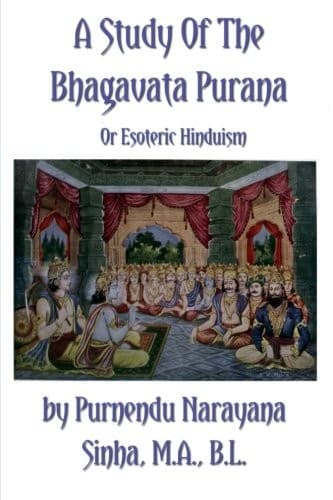
A Study of the Bhâgavata Purâna; or, Esoteric Hinduism
Religion
A Study of the Bhâgavata Purâna; or, Esoteric Hinduism
Puranas. Bhagavatapurana. English
It is the _existence_ aspect of the underlying ray of the Absolute
Brahmân, in every individual, that gives a continuity to individual
existence, through thousands of births and experiences, and makes
individual evolution a possibility.
The _consciousness_ aspect of the ray unfolds the blunt inanimate sense
into the most highly developed mind. It gives the wisdom side of man’s
evolution, which leads to the path of Jnâna.
Then there is the _Bliss_ aspect of the ray, which directly leads to the
union of the human soul with the Over-soul, of Jiva with Íshvara, and it
leads to the path of Bhakti. It is the sensation of pleasure that makes
the lowest organic form, the primordial cell, break through the inertia
of Tamas. The cell moves about, either for cell union or for the
assimilation of food, because these give rise to some sensation, call it
pleasurable, if you like. It is not so easy to form an idea of the
sensation of pleasure in the vegetable kingdom, but the excitement
caused by the union of the sperm cell with the germ cell cannot but
strike any one with the existence of some such feeling, though in a most
rudimentary state.
Animals feel pleasure in the company of their female partners. They also
love their offspring. This gives rise to family connections, to the
formation of society and of social virtues. With the evolution of body
and mind, pleasures become many-sided, and the acquirement of pleasure
becomes in itself the principal factor in the development of man. Man
seeks his pleasure outside himself, and he does so either for himself or
for others. A point is reached when self is lost sight of and self
sacrifice for the good of others becomes a duty of pleasure. Self is
estranged from the narrow groove of personality. It tries to identify
itself with all beings. There is philanthropy, there is universal
kindness. Still the differences cause unrest and disquiet. Self finds no
rest, till it seeks its reality, till it makes a homeward journey, for
even its own personality and the outside world lose all charm for it.
Self finds bliss in self void of personality. This is spiritual bliss
attained by those that are Antarmukh (facing inwards) and not by those
that are Bahir Mukh (facing outwards). Self when seeking self becomes
united to the universal self as its eternal friend and its real aspect.
The universal self in Vrindâvana is Sri Krishna. And the bliss of the
Gopis is self-attainment, attachment to self or Âtmâ and not to non-self
or worldly connections.
It is to those and those only that eagerly desire to make this inward
journey that the Vrindâvana Lilâ is addressed.
Public-domain text, read in full here on John Shaqi.
Reviews
Reviews
No reviews yet
Be the first to share your thoughts on this work.
Elsewhere in the archive
Join the Discussion
Join the discussion
Sign in to leave a comment or review.
Sign InorCreate an account