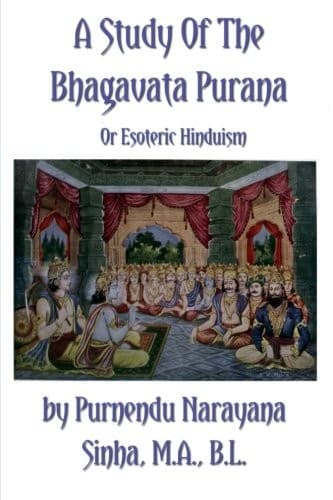
A Study of the Bhâgavata Purâna; or, Esoteric Hinduism
Religion
A Study of the Bhâgavata Purâna; or, Esoteric Hinduism
Puranas. Bhagavatapurana. English
Kardama, the husband of Devahûti, was born of Brahmâ’s Chhâya or shadow.
So there was creation out of the body and the mind of Brahmâ. Brahmâ
took a fancy to his daughter Vâk (or speech). Marichi and his other sons
dissuaded him from the incestuous connection. And the Creator in shame
gave up his body which was taken up by Space and which is known as dewy
darkness. "How shall I bring back all the previous Creation?" So thought
Brahmâ at one time, and the four Vedas appeared from his four mouths.
The Yajnas, the Upavedas, the Philosophies, the four parts of Dharma,
and the duties of Âsramas also appeared.
Brahmâ had another body void of incestuous impulses and he thought of
enlarging the Creation. But he found himself and the Rishis, powerful
though they were, unsuccessful in this respect. He thought there was
some unforeseen impediment, so he divided his body into two. A pair was
formed by that division. The male was Svâyambhuva Manu and the female
was his wife Śatarûpâ. Since then creation multiplied by sexual
intercourse. Svâyambhuva Manu begot five children in Śatarâpâ — two
sons, Priyavrata and Uttânapâda, and three daughters, Âkûti, Devahûti
and Prasûti. He gave Akuti in marriage to Ruchi, Devahûti to Kardama and
Prasûti to Daksha. This changing universe is filled with their progeny.
PRE-MANVANTARIC CREATION.
The descent of Spirit into Matter is indicated by the overshadowing
Tamas creation, The individuals reach the spiritual plane at the time of
Pralaya and lose all sense of I-ness. Their memory becomes perfectly
dead to all previous connections and experiences and even as to self as
a distinct unit. The child starts with a body of his own, and faculties
limited to that body. The Jiva children that came into existence at the
beginning of the Universe had however nothing peculiar to themselves,
and they had even to acquire the sense of I-ness.
First, the Jiva identifies himself with his body and mind, his own
phenomenal basis. For, if he identifies himself with the universal
spirit, there is no action for him, no working out of his own Karma.
Though from the standpoint of the highest wisdom individuality is a
delusion, for the one unchangeable ever-lasting element in Jiva is Âtmâ,
and at the final stage of development man has to separate himself from
his phenomenal basis and to identify himself with Âtmâ, which is the
real self, still the sense of separateness is necessary for the process
of creation and for the gaining of experiences. This sense is
two-fold,--
1) The non-perception of Âtmâ as Self, called Avidyâ by Patanjali and
Tamas in the Purânas, and
2) The perception of the _upâdhi_ as self, called Asmitâ by Patanjali
and Moha in the Purânas.
Public-domain text, read in full here on John Shaqi.
Reviews
Reviews
No reviews yet
Be the first to share your thoughts on this work.
Join the Discussion
Join the discussion
Sign in to leave a comment or review.
Sign InorCreate an account