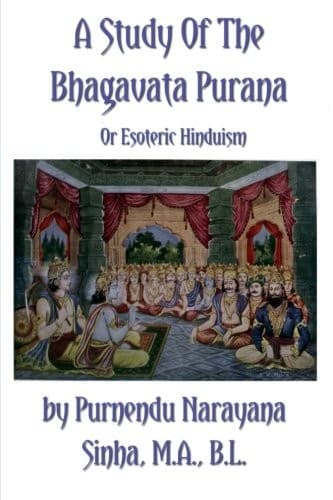
A Study of the Bhâgavata Purâna; or, Esoteric Hinduism
Religion
A Study of the Bhâgavata Purâna; or, Esoteric Hinduism
Puranas. Bhagavatapurana. English
"Buddhi is Râjasa transformation of Ahankâra. The perception of objects,
dependence on the Indriyas, doubt, wrong-knowledge, right-knowledge,
memory and sleep these are the functions of Buddhi. (Pradyumna is the
Purûsha of Buddhi.)"
[The terminology here adopted will appear strange to the Vedantin
scholar. The divisions of Antahkarana are here adopted to the sacred
Tetractys or Chatur-vyuha, consisting of Vâsudeva, Sankarshana,
Aniruddha and Pradyumna. In Devotional practice, Antahkarana should be
made the channel for higher communion and its divisions are the
divisions of spiritual perception.
Chitta is the highest aspect of Antahkarana corresponding to Mahat Tatva
in the Universe, with the Purusha always reflected in it. This aspect
corresponds to Vâsudeva, the highest Purusha in the Tetraktys.
Ahankâra is the bare individuality, transformable into peculiarities,
but not so transformed. Sankarshana is the corresponding Purusha.
Manas is Kâma or desire brought on by likes and dislikes. It consists of
the mental tendencies of attachment, repulsion and indifference.
Aniruddha is the corresponding Purusha.
Buddhi is in one word the Chitta of Patanjali, — that which functions
through the physical brain.
Pradyumna is the corresponding Purusha.]
"The Indriyas are also the Rajasika transformations of Ahankâra."
Prana through its Kriyâ Śakti gave rise to the Karma Indriyas. Buddhi
through its Jnâna Śakti gave rise to the Jnâna Indriyas. The Tanmatras
and the Maha Bhûtas then came out in order of transformation. All these
principles could not, however, unite to bring forth the creation.
Purusha then permeated them, and the Cosmic Egg with its covers was
formed. Details are given as to how the Indriyas and Antahkarana with
their Adhyâtma, Adhibhûta and Adhidaiva appearing in the Virâta Purusha,
rose up from sleep as it were only when Chitta finally appeared.
Kapila then dilated on the relations between Purusha and Prakriti, using
the illustration of the sun reflected on water and re-reflected on the
wall. He showed how Mukti could be attained by discrimination of
Prakriti and Purusha — the seer and the seen.
Public-domain text, read in full here on John Shaqi.
Reviews
Reviews
No reviews yet
Be the first to share your thoughts on this work.
Join the Discussion
Join the discussion
Sign in to leave a comment or review.
Sign InorCreate an account