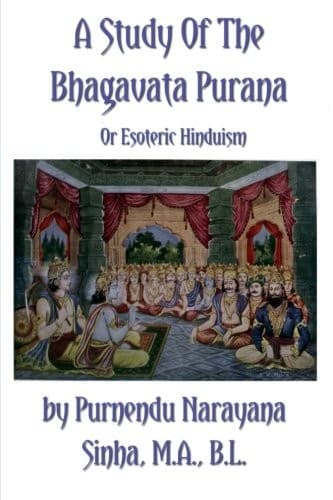
A Study of the Bhâgavata Purâna; or, Esoteric Hinduism
Religion
A Study of the Bhâgavata Purâna; or, Esoteric Hinduism
Puranas. Bhagavatapurana. English
Devahûti asked how Mukti was possible when Prakriti and Purusha were
eternally co-existent, and inter-dependent in manifestation. A man might
for a time realize that the Purusha was free from the fears of
relativity, but his Karma had connected him with the Gunas and the fears
would recur as the ultimate cause could not be removed. Kapila replied,
"By unselfish performance of duties, by purification of mind, by intense
Bhakti in Bhagavân fostered by the recital of His glory, by wisdom based
on the knowledge of the Tatvas, by strong dispassion, by austere yoga,
by intense concentration on Âtmâ, Prakriti becomes daily subdued and it
is finally consumed, even as the wood is consumed by its own fire,
caused by constant friction. Given up as already enjoyed and constantly
found fault with, Prakriti does no harm to the Purusha centred in Self.
Dreams do harm in sleep. But when a man wakes up, they lose all power to
injure, as they are then found to be dreams only."
Kapila then explained the Ashtânga Yoga of Patanjali, as adapted to
Bhakti and gave a graphic description of Vishnu as the object of
meditation.
He then explained Bhakti Yoga. Bhakti Yoga is either Saguna or Nirguna.
As Saguna it is either Satvika, Râjasika or Tamasika.
Nirguna Bhakti Yoga is that in which the mind runs towards Bhagavân,
even as the Ganges runs towards the Sea, with a constant spontaneous
flow. The Devoted spurn Sâlokya, Sârshti, Sâmipya, Sârûpya and Sâyujya
union¹ even when offered to them and they prefer to serve Bhagavân ever
and ever. Compassion and friendliness to all beings are the essential
qualifications of the Devoted. They must be humble, respectful and self
controlled. They must pass their days in hearing and reciting the glory
of Bhagavân.
Kapila then described in vivid terms the life and death of a man of the
world and his passage after death to Yâma Loka. He described the rebirth
and went through every detail of fœtal existence. The fœtus acquires
consciousness in the seventh month and gets a recollection of previous
births. This recollection is lost on being born.
Those who selfishly perform their Dharma and worship Devas and Pitris go
to Sōma Loka, and after partaking of Sōma, they are again re-born. And
even their Lokas are destroyed with the daily Pralaya of Brahmâ.
Those who unselfishly perform their duties and give themselves up
entirely to the Supreme Purusha go through Sûrya (Sun) to the
transcosmic Loka of Parama Purusha. The worshippers of Hiranyagarbha
(Brahmâ) reach Brahmâ Loka or Satya Loka and there wait for two
Parârddhas _i.e._ for the life time of Brahmâ and upon the final
dissolution of the Brahmânda go to the trans-cosmic plane of Parama
Purusha.
Brahmâ, Marichi and other Rishis, the Kumâras and Siddhas do their
assigned work unselfishly, but their Upâsanâ admits of distinction. So
they are absorbed in the Second or the First Manifested Purusha at
Pralaya and become re-born at creation.
Public-domain text, read in full here on John Shaqi.
Reviews
Reviews
No reviews yet
Be the first to share your thoughts on this work.
Join the Discussion
Join the discussion
Sign in to leave a comment or review.
Sign InorCreate an account