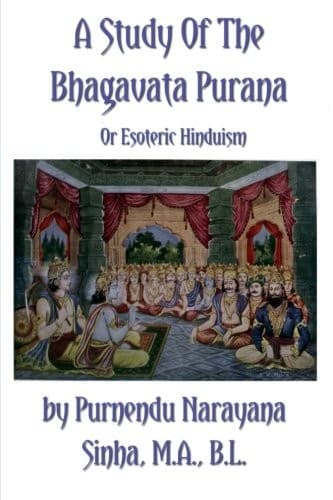
A Study of the Bhâgavata Purâna; or, Esoteric Hinduism
Religion
A Study of the Bhâgavata Purâna; or, Esoteric Hinduism
Puranas. Bhagavatapurana. English
The Gitâ lays down Nishkâma Karma, or the unselfish performance of the
duties of life (Sva-dharma) as the first step towards reaching the
higher planes. The sense of separateness is killed by Nishkâma Karma.
Then the Gitâ takes the disciple to Upâsanâ or communion with the
Purusha of the highest plane, but scarcely a glimpse is given of that
plane and its surroundings. The Mahâbhârata does not throw any light on
the dwellers of the higher planes, nor does it give any details of those
planes. Without any distinct prospect of trans-Trilokî life, one is
asked to adhere to the duties appertaining to one’s own sphere of life
(Sva-dharma) and to perform those duties unselfishly. However transitory
the things of Trilokî may be, there are attractions enough for the frail
sons of Manu, abounding in passions and desires. What can then bind a
man to the higher planes and the highest Purûsha of those planes or
Bhagavân? It is only a description of the grandeur and the glory of
those planes and of Bhagavân. Such description begets Bhakti or holy
attachment, and it is this Bhakti which sets up a real communion with
Bhagavân. Frail as man is, the mere performance of duties makes him
attached to them, unless he is bound to the higher planes by the tie of
holy attachment. The Gitâ is however silent as to the attractions of the
higher planes and of Bhagavân. This was the defect pointed out by
Nârada.
"O thou great Muni, as thou hast treated of Dharma and of other things,
so thou hast not recited the glory of Vâsudeva". — I. 5. 9.
"This universe is also an aspect of Bhagavân, for its creation,
preservation and end proceed from Him. Thou knowest all this thyself.
But thou hast shown to others only a portion of this truth." — I. 5.
20.
"Salutations to Thee, Bhagavân, let me meditate on Vâsudeva. Salutations
to Pradyumna, Aniruddha and to Sankarshana. He who, by naming these
_mûrtis_ in the _mûrtiless_, whose only _mûrti_ is mantra, makes
offerings to Yajna Purusha, is the complete seer." — I. 5. 37-38. A
mystery lies veiled in this Śloka.
But who is this Nârada? Why should we accept his authority? Nârada was
therefore careful to give his own account, elaborated by the enquiries
of Vyâsa. All students of occultism will do well to read carefully this
account which forms a fitting preliminary to the Bhâgavata.
ACCOUNT OF NARADA.
*SKANDHA I. CHAP. 5 & 6.*
Public-domain text, read in full here on John Shaqi.
Reviews
Reviews
No reviews yet
Be the first to share your thoughts on this work.
Join the Discussion
Join the discussion
Sign in to leave a comment or review.
Sign InorCreate an account