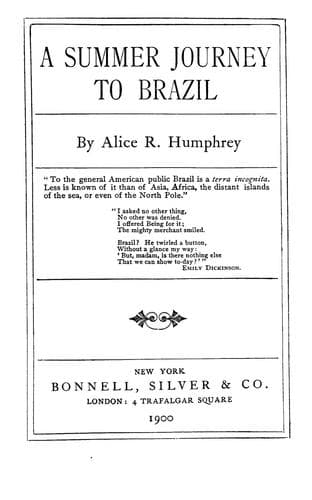
Brazil -- Description and travel; São Paulo (Brazil : State)
You cannot help being properly excited when you anchor off your first
Brazilian city, Pernambuco--the sugar-shipping port. It lies two
miles away--a low line of light-colored buildings with palm trees
interspersed. Between you and it is the strange wall, the natural
breakwater, which looks as if some human engineer had planned it there;
narrow, level, twelve feet above high water, with the surf broken into
white foam against its side. This reef follows the coast for several
hundred miles, but not always above the water line. Opposite your
anchorage is the break in the wall which would let a lighter vessel
than yours over the reef; and in the quiet harbor lie the smallish
craft from everywhere. At the end of the reef near you is an old bit of
a Dutch fort, and it dawns on your mind that in the colonizing times
between 1530 and 1660 this land was owned successively by Portugal,
Spain, England, Holland and finally by Portugal again.
[Illustration: REEF PERNAMBUCO.]
You may feel very superior in some ways to what you see when you go
ashore, but not in the antiquity of your country nor the superiority
of your coffee. The truth is you are in a life wholly different from
anything you live in at home. You look down the narrow streets at
buildings which remind you of the different colonists who built there.
Close by is a public building, the outside walls of which are faced in
pattern with glazed tiles in green and yellow like your neighbor’s new
mantelpiece. Next is a stucco building, tinted to imitate pink marble,
with sky-blue trimmings. It makes you laugh, it’s all so gay, but it
seems pleasant after all that any people should want their very houses
and stores and town halls to look so cheerful. You are not quite used
to seeing fair-sized children in the street without clothes, but they
are black mostly who avail themselves of such liberty. You look at
the street cars, which your English companion calls a “tram” and your
Brazilian escort a “bond,” and their unsleek little mules with their
long fur all welted where they have been beaten, suggest room for a
Society for the Prevention of Cruelty to Animals.
You ride over the long iron bridge built in Dom Pedro’s time to the
suburb where fine residences make you realize anew how the people
love brightness--for in the gardens are not only brilliant flowering
plants, but wire frames among the shrubbery holding great quicksilvered
balls, and your confused sense is of a continuous Christmas tree in hot
weather with no gift for you. Indeed you feel in a very foreign land.
There is not a tree or plant you have seen outside of greenhouses. The
colors are all more brilliant, the motions more slow, the greetings
more elaborate, the beggars more loathsome, the whole place more
ancient and semi-decayed than anything you know. Every wall is thick to
keep out the heat, every window has its “Venetian,” behind which you
fancy are eyes.
Public-domain text, read in full here on John Shaqi.
Reviews
Reviews
No reviews yet
Be the first to share your thoughts on this work.
Join the Discussion
Join the discussion
Sign in to leave a comment or review.
Sign InorCreate an account