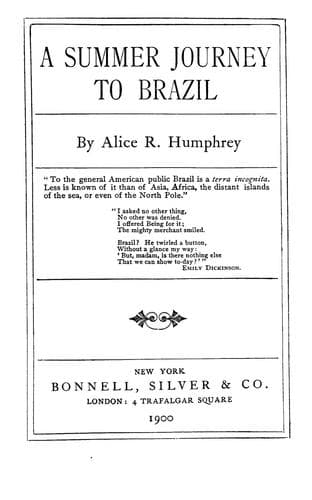
Brazil -- Description and travel; São Paulo (Brazil : State)
Coming down on the steamer you became deeply interested in all you
heard of it. A nobleman, who shared his Emperor’s banishment ten years
ago when the republic began, was making a brief visit to his old
home. One day he said very sadly to some American people of Brazilian
experience: “What do you think of my country since the republic?” The
gentlemen replied: “It has improved in many ways.” The Count said:
“You are republicans, of course; yet is not my country very different
from yours?” “Yes, _because there has been no education of the common
people, and they have not been accustomed to self-control_.” Then an
outline of what American missionary schools are trying to do for all
grades, “gentle and simple,” in this city, was given, to his great
surprise.[5]
[5] See Appendix.
Here are items you find in your reading:
“Less than thirty years ago it was common for men to lock their wives
and daughters securely in the upper story when they went to business,
or if absent for any length of time to deliver them to a convent for
safekeeping. No respectable woman could go alone on the streets of any
of the large towns.
“The story of Puerto Rico, the Philippines and Cuba is the story of
Brazil and all countries where Rome has held undisturbed sway. In the
seventeen and one-half millions of Roman Catholic Brazilians there is
82 per cent. of illiteracy and an enormous per cent. of illegitimacy
and crime.
“The first missionaries of the Presbyterian Board landed in Brazil
in 1860. Every avenue to knowledge was held by the State Church and
the Jesuits had control. Private schools were subject to priestly
inspection. Protestantism was fiercely opposed by State, Church and
people. Men who dared to preach the Gospel publicly, risked their
lives.”
In 1885, their schools had been opened fifteen years. “Under the
influence of Protestantism, or at any rate coincident with the growth
of Presbyterian schools and churches in Brazil, new and more liberal
educational laws were enacted. Influences were at work in society which
in the near future were to abolish slavery, overthrow monarchy, set up
a government of the people and separate Church from State.”
In 1889 “Mackenzie College” was begun. In 1890 their record stands: “A
boys’ boarding school, a girls’ boarding school, and a day school in
the rua São João, with thirteen rooms for teaching purposes--a normal
department with four rooms, all full to overflowing--an enrolment of
four hundred and forty-seven pupils in all grades from kindergarten to
high school. Eighteen primary schools in different parts of the field
with an efficient corps of native teachers, and a self-supporting
manual training school.”
Public-domain text, read in full here on John Shaqi.
Reviews
Reviews
No reviews yet
Be the first to share your thoughts on this work.
Join the Discussion
Join the discussion
Sign in to leave a comment or review.
Sign InorCreate an account