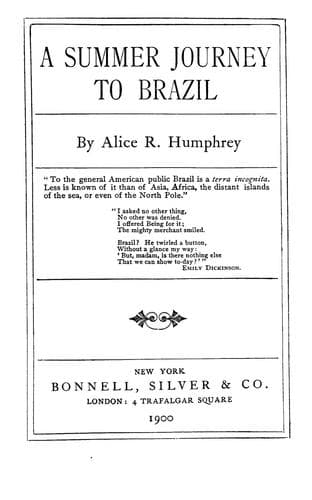
Brazil -- Description and travel; São Paulo (Brazil : State)
1. A primary school of five years, with a minimum of 100 school days of
five hours each per annum, for the ungraded country schools, and 210
(a full school year) for the graded city schools. This course embraces
Reading, Writing and the four operations of Arithmetic. Arithmetic is
made the test of advancement, but great attention is also paid to
Expression and Language, and, very early, small vocabularies of the
_two modern languages_, that are to be studied systematically later,
are introduced by the “natural method” (French and English by French
and English teachers), with pleasure and profit to the pupils; thus
in the very beginning of school life the habit of comparing modes of
expression is cultivated, which later will be applied to processes.
Through Geography the study of nature is begun and our relations to the
world in which we live are studied; through Manual training, and the
drawing preliminary to it, _things_ and their relations are studied
and the child is taught to _do_ and _see_ as well as to think. This is
that part of education which society, for its own safety, _must demand_
for every girl and boy in the land. It is all that can be given to the
masses, the very poor, the wage-earner’s children, who must go to work
early in life. Very bright pupils, with intellectual surroundings, may
complete this course easily in four years, as many have done far better
than others in five.
2. A Secondary course of six years divided into two periods of three
years each. This is an expansion of the primary, extending mathematics
to meet all requirements of practical life; cultivating carefully
the mother tongue, giving some notions of the two modern languages;
thorough training in Brazilian Geography and History, with outlines of
General History and Geography; Manual training and mechanical drawing,
etc. This first section embraces that part of an education essential
to GOOD citizenship, within reach of all, but not compulsory--a short
Grammar school course. The second section is a preparation for College,
without, however, special reference to a college course. In it the two
modern languages are finished; Algebra and Geometry are studied, Latin
begun, etc., going about a year further than the average High-school
course of the United States. This completes the common school system
and prepares the pupil for the highest duties of citizenship.
[Illustration: COFFEE DRYING]
The bright pupil who has finished the primary course in four years may
complete this in five. This has been frequently done, and is the
rule for those preparing for College.
The student who does this is ready for College at fifteen.
Public-domain text, read in full here on John Shaqi.
Reviews
Reviews
No reviews yet
Be the first to share your thoughts on this work.
Join the Discussion
Join the discussion
Sign in to leave a comment or review.
Sign InorCreate an account