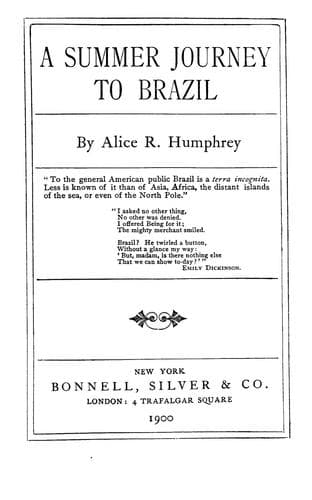
Brazil -- Description and travel; São Paulo (Brazil : State)
We believe the tendency of American education is to return somewhat to
the _Humanities_, enrich the secondary school with studies heretofore
included in the advanced courses, and thus shorten the College course.
This is the language period of life, and fourteen years’ experience has
shown us that the two modern languages can be easily carried parallel
to the mother tongue, with benefit to the pupil. It furnishes excellent
mental discipline and has the advantage of awakening the habit of
comparison earlier. There is a slight sacrifice of the mathematical
or scientific side, which is pushed into the next division where it
logically belongs.
The first division in this system aims to reach the great mass of
society and force it up to the level of _safe_ and intelligent
citizenship. The second reaches after the great middle class and
purposes to fit its members for the highest duties of citizenship,
as well as equip them for trade, manufactures and all legitimate
activities, at public expense. It gives a sufficient amount of
formulated knowledge and mental training to enable them to continue
their studies independently through the opportunities afforded by the
Press, public libraries and lectures.
The next step embraces three years of a _culture_ course for that
comparatively small class who desire to take a profession, or
wish a _liberal education_ in literature, art and sciences, as a
stepping-stone to still more advanced studies. Entrance to this
class ought to be guarded by severe tests in order to exclude the
weak-brained who want a degree simply as an ornament and because they
can pay for it. The brainy, poor young man can always find means.
This is the College, reduced to three years. It lies between the
public school system and the specialized University courses,--not
absolutely necessary but highly advisable. It is where the student
is thrown into the larger current of independent action and takes on
the responsibilities as well as the privileges of manhood, either to
prepare for entrance into the higher spheres of active life or to enter
upon other studies.
This gives a minimum of school life, at public expense, of four years
and a maximum of eleven years.
Public-domain text, read in full here on John Shaqi.
Reviews
Reviews
No reviews yet
Be the first to share your thoughts on this work.
Join the Discussion
Join the discussion
Sign in to leave a comment or review.
Sign InorCreate an account