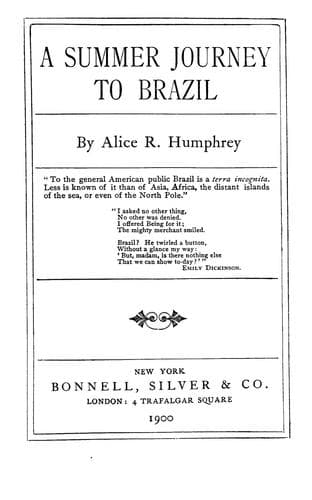
Brazil -- Description and travel; São Paulo (Brazil : State)
2.--We may easily overestimate the value of perfunctory religious
exercises, as we may also overestimate the capacity of children to
understand formulated religious truth. The child’s perceptions are
duller in this than in other branches of knowledge, where his senses
are engaged, hence the necessity of grading it more carefully and
watching its effects more closely.
3.--Schools are not chiefly, nor primarily, to teach religion, i. e.,
to instruct in creeds. Considered in its relation to courses of study,
religious instruction is a _means_ for the development of character and
for giving a sure foundation for moral training; but, in its relation
to the pupil, it is an absolute _end_; giving to him, as he can
comprehend it, the saving truths of Christianity.
The first is directly related to courses of study and from it
definite results may be expected; the other depends upon the subtle
and immeasurable spiritual power of the Christian teacher, and no
definite results can be demanded. The first has a recognizable,
educational value and its correlates are easily found; the other has
no appreciable relation to hours of recitation or quantity of matter
and cannot enter into any plan of correlation of studies. It touches
all studies and permeates all methods, the greatest result often coming
from the least matter; its educational value, therefore, cannot be
measured.
4.--We may not safely assume that the child has received from parents
or church proper religious instruction, but we may suppose, in
nominally Christian lands, that it has some ideas, however vague and
erroneous, of God. It is the duty of the teacher to adjust these ideas
to the truth, and so relate them to the child that he may _feel sure_
that _there is a God_,--though he cannot see Him,--Who is All-wise,
All-seeing, All-powerful: who is everywhere and who loves him, the
child, personally; that God is his Heavenly Father; that the Bible is
God’s Word, sent to him, the child, and to everybody else; that God
sent His Son to save the world; that Christ is God and God is Christ;
that God made everything,--even we ourselves are the work of His hand.
These are fundamentals, and must precede all other instruction. The
clearness with which the children perceive these truths will depend
largely upon the skill and spiritual power of the teacher.
Public-domain text, read in full here on John Shaqi.
Reviews
Reviews
No reviews yet
Be the first to share your thoughts on this work.
Join the Discussion
Join the discussion
Sign in to leave a comment or review.
Sign InorCreate an account