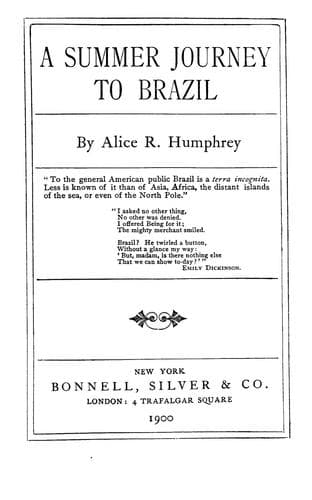
Brazil -- Description and travel; São Paulo (Brazil : State)
Education will, therefore, be finished at these ages: The large class
of children of the very poor, at ten or eleven years. Another class
will go out at the end of the first period of the secondary (the old
Grammar course) and enter society fairly well equipped for the ordinary
pursuits of life at twelve or thirteen. The second class completes
school life, at the end of the public school course, at the age of
fourteen or fifteen, well educated; a still smaller class completes the
liberal College course at seventeen or eighteen, while the winnowing
of all classes produces the comparatively small group of scholars and
professionals who are able to enter life fully equipped, with such
knowledge as can be obtained from books, at twenty-one to twenty-two.
The student who skips the College and short-circuits from the High
School to the University may graduate from his professional course with
honor at nineteen or twenty, but will always lack that something that
enables the man with the wider culture and discipline to win in the
race of life.
The points in which the foregoing differs from the plan commonly
adopted in United States are: the introduction of two modern languages
at the language period of life, for their own value, to improve the
study of the mother tongue and to develop earlier the comparative
process as mental discipline; the shortening of the College course to
three years and reducing school life by at least two and possibly three
years, leaving some of the enthusiasm of youth for the first years
of independent self-supporting life, also shortening the period of
parental support.
No attempt is made here to indicate the exact organization of the
various courses; the purpose and logical distribution is what is
sought to show. We have been able to see the finished product of the
system and feel sure it is an improvement upon the old plan. This is
the system of schools known as “Mackenzie College” and the “Eschola
Americana” at S. Paulo, Brazil, and is intended to serve, in a modest
way, as a model of American education for Brazil.--_Dr. H. M. Lane, in
The Brazilian Bulletin._
RELIGIOUS INSTRUCTION IN SCHOOLS.
There is much vague talk about religious teaching, its relation to
other branches, the time that can be given to it, its character, etc.
In order to show what we think about it, we venture to give extracts
from our last annual circular to the teachers of the American schools
at S. Paulo on the subject.
General considerations to which the attention of young teachers is
called:
1.--The opening of school is not a religious ceremony, but a
_devotional_ exercise. If arranged with skill it may be made so
attractive to children that none will want to miss it (thus tardiness
may be diminished); if it holds attention, it cannot fail to teach the
lesson.
Public-domain text, read in full here on John Shaqi.
Reviews
Reviews
No reviews yet
Be the first to share your thoughts on this work.
Join the Discussion
Join the discussion
Sign in to leave a comment or review.
Sign InorCreate an account