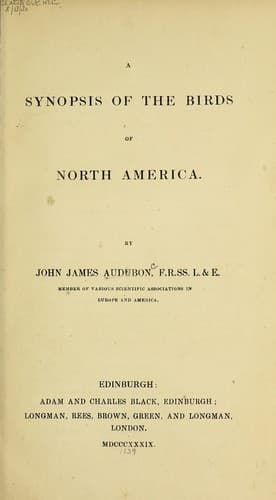
A Synopsis of the Birds of North AmericaAudubon, John James
Science
A Synopsis of the Birds of North America
Audubon, John James
Birds -- Classification; Birds -- North America
Bill longer than the head, nearly straight, tetragonal at the base,
suddenly extremely compressed and continuing so to the end; upper
mandible much shorter than the lower, its ridge sharp, the sides erect
but a little convex, the edges approximated so as to leave merely a
very narrow groove between them, the tip a little rounded, when viewed
laterally; nasal groove rather short, near the margin; lower mandible
with the angle extremely short, the dorsal line straight or slightly
decurved, the sides erect, obliquely grooved, the edges united into a
very thin blade, which fits into the narrow groove of the upper
mandible, the tip rounded or abrupt, when viewed laterally. Nostrils
linear-oblong. Head rather large, oblong, considerably elevated in
front; neck rather short, thick; body short, ovate. Feet short,
moderately stout; tibia bare below, with narrow transverse scutella
before and behind; tarsus short, anteriorly covered with broad
scutella; toes very small, the first extremely short and free, unless
at the base; middle toe slightly longer than outer; anterior toes
united by deeply emarginate webs. Claws long, compressed, slightly
arched, rather obtuse. Plumage moderately full, soft, and blended;
wings extremely long, and very narrow; primary quills excessively
long, the first longest; secondaries short. Tail of moderate length,
deeply forked, of twelve feathers. Tongue short, triangular, tapering;
œsophagus wide; stomach rather small, oblong, muscular, the
cuticular lining dense, with nine broad longitudinal rugæ; intestine
rather long, narrow; cœca very small; cloaca large, globular, the
digestive organs are precisely similar to those of the Terns and
smaller Gulls.
428. 1. Rhynchops nigra, Linn. Black Skimmer.
Plate CCCXXIII. Male
Bill rich carmine in its basal half, the rest black; feet carmine;
upper plumage deep brownish-black; secondary quills and four or five
of the primaries tipped with white, the latter on the inner web
chiefly; tail-feathers black, broadly margined on both sides with
white, the outer more extensively; the middle tail-coverts black, the
lateral black on the inner, and white on the outer web; a broad band
of white over the forehead, extending to the fore part of the eye;
cheeks and throat of the same colour; the rest of the neck, and lower
parts in spring and autumn of a delicate cream-colour; axillary
feathers, lower wing-coverts, and a large portion of the secondary
quills, white, the coverts along the edge of the wing black. Female
smaller, similar to the male, but with the tail-feathers white,
excepting a longitudinal band including the shaft. After the first
autumnal moult, there is on the hind part of the neck a broad band of
white mottled with greyish-black; the lower parts pure white, the
upper of a duller black; bill and feet less richly coloured.
_Male_, 20, 48. _Female_, 16-3/4, 44-1/2.
Public-domain text, read in full here on John Shaqi.
Reviews
Reviews
No reviews yet
Be the first to share your thoughts on this work.
Elsewhere in the archive
Join the Discussion
Join the discussion
Sign in to leave a comment or review.
Sign InorCreate an account