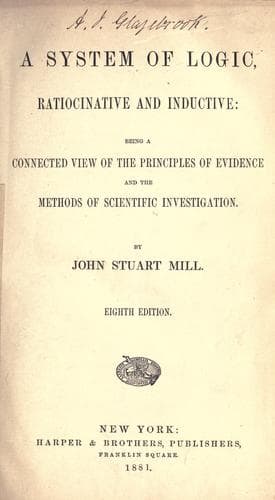
A System of Logic, Ratiocinative and InductiveMill, John Stuart
PhilosophyPhilosophy
A System of Logic, Ratiocinative and Inductive
Mill, John Stuart
Knowledge, Theory of; Logic; Science -- Methodology
Of The Nature Of Classification, And The Five Predicables.
§ 1. In examining into the nature of general propositions, we have
adverted much less than is usual with logicians to the ideas of a Class,
and Classification; ideas which, since the Realist doctrine of General
Substances went out of vogue, have formed the basis of almost every
attempt at a philosophical theory of general terms and general
propositions. We have considered general names as having a meaning, quite
independently of their being the names of classes. That circumstance is in
truth accidental, it being wholly immaterial to the signification of the
name whether there are many objects, or only one, to which it happens to
be applicable, or whether there be any at all. God is as much a general
term to the Christian or Jew as to the Polytheist; and dragon, hippogriff,
chimera, mermaid, ghost, are as much so as if real objects existed,
corresponding to those names. Every name the signification of which is
constituted by attributes, is potentially a name of an indefinite number
of objects; but it needs not be actually the name of any; and if of any,
it may be the name of only one. As soon as we employ a name to connote
attributes, the things, be they more or fewer, which happen to possess
those attributes, are constituted _ipso facto_ a class. But in predicating
the name we predicate only the attributes; and the fact of belonging to a
class does not, in many cases, come into view at all.
Although, however, Predication does not presuppose Classification, and
though the theory of Names and of Propositions is not cleared up, but only
encumbered, by intruding the idea of classification into it, there is
nevertheless a close connection between Classification and the employment
of General Names. By every general name which we introduce, we create a
class, if there be any things, real or imaginary, to compose it; that is,
any Things corresponding to the signification of the name. Classes,
therefore, mostly owe their existence to general language. But general
language, also, though that is not the most common case, sometimes owes
its existence to classes. A general, which is as much as to say a
significant, name, is indeed mostly introduced because we have a
signification to express by it; because we need a word by means of which
to predicate the attributes which it connotes. But it is also true that a
name is sometimes introduced because we have found it convenient to create
a class; because we have thought it useful for the regulation of our
mental operations, that a certain group of objects should be thought of
together. A naturalist, for purposes connected with his particular
science, sees reason to distribute the animal or vegetable creation into
certain groups rather than into any others, and he requires a name to
bind, as it were, each of his groups together. It must not, however, be
supposed that such names, when introduced, differ in any respect, as to
Public-domain text, read in full here on John Shaqi.
Reviews
Reviews
No reviews yet
Be the first to share your thoughts on this work.
Elsewhere in the archive
Join the Discussion
Join the discussion
Sign in to leave a comment or review.
Sign InorCreate an account