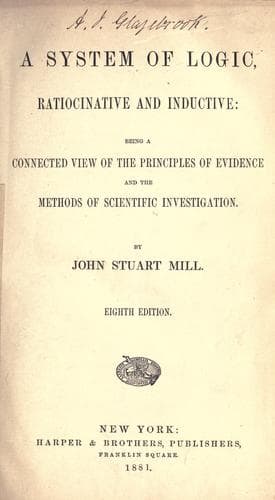
A System of Logic, Ratiocinative and InductiveMill, John Stuart
PhilosophyPhilosophy
A System of Logic, Ratiocinative and Inductive
Mill, John Stuart
Knowledge, Theory of; Logic; Science -- Methodology
Of the science, therefore, which expounds the operations of the human
understanding in the pursuit of truth, one essential part is the inquiry:
What are the facts which are the objects of intuition or consciousness,
and what are those which we merely infer? But this inquiry has never been
considered a portion of logic. Its place is in another and a perfectly
distinct department of science, to which the name metaphysics more
particularly belongs: that portion of mental philosophy which attempts to
determine what part of the furniture of the mind belongs to it originally,
and what part is constructed out of materials furnished to it from
without. To this science appertain the great and much debated questions of
the existence of matter; the existence of spirit, and of a distinction
between it and matter; the reality of time and space, as things without
the mind, and distinguishable from the objects which are said to exist in
them. For in the present state of the discussion on these topics, it is
almost universally allowed that the existence of matter or of spirit, of
space or of time, is in its nature unsusceptible of being proved; and that
if any thing is known of them, it must be by immediate intuition. To the
same science belong the inquiries into the nature of Conception,
Perception, Memory, and Belief; all of which are operations of the
understanding in the pursuit of truth; but with which, as phenomena of the
mind, or with the possibility which may or may not exist of analyzing any
of them into simpler phenomena, the logician as such has no concern. To
this science must also be referred the following, and all analogous
questions: To what extent our intellectual faculties and our emotions are
innate—to what extent the result of association: Whether God and duty are
realities, the existence of which is manifest to us _a priori_ by the
constitution of our rational faculty; or whether our ideas of them are
acquired notions, the origin of which we are able to trace and explain;
and the reality of the objects themselves a question not of consciousness
or intuition, but of evidence and reasoning.
The province of logic must be restricted to that portion of our knowledge
which consists of inferences from truths previously known; whether those
antecedent data be general propositions, or particular observations and
perceptions. Logic is not the science of Belief, but the science of Proof,
or Evidence. In so far as belief professes to be founded on proof, the
office of logic is to supply a test for ascertaining whether or not the
belief is well grounded. With the claims which any proposition has to
belief on the evidence of consciousness—that is, without evidence in the
proper sense of the word—logic has nothing to do.
Public-domain text, read in full here on John Shaqi.
Reviews
Reviews
No reviews yet
Be the first to share your thoughts on this work.
Join the Discussion
Join the discussion
Sign in to leave a comment or review.
Sign InorCreate an account