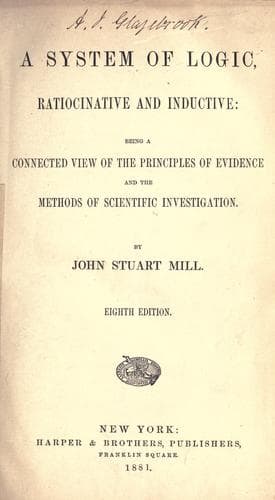
A System of Logic, Ratiocinative and InductiveMill, John Stuart
PhilosophyPhilosophy
A System of Logic, Ratiocinative and Inductive
Mill, John Stuart
Knowledge, Theory of; Logic; Science -- Methodology
§ 5. By far the greatest portion of our knowledge, whether of general
truths or of particular facts, being avowedly matter of inference, nearly
the whole, not only of science, but of human conduct, is amenable to the
authority of logic. To draw inferences has been said to be the great
business of life. Every one has daily, hourly, and momentary need of
ascertaining facts which he has not directly observed; not from any
general purpose of adding to his stock of knowledge, but because the facts
themselves are of importance to his interests or to his occupations. The
business of the magistrate, of the military commander, of the navigator,
of the physician, of the agriculturist, is merely to judge of evidence,
and to act accordingly. They all have to ascertain certain facts, in order
that they may afterward apply certain rules, either devised by themselves
or prescribed for their guidance by others; and as they do this well or
ill, so they discharge well or ill the duties of their several callings.
It is the only occupation in which the mind never ceases to be engaged;
and is the subject, not of logic, but of knowledge in general.
Logic, however, is not the same thing with knowledge, though the field of
logic is co-extensive with the field of knowledge. Logic is the common
judge and arbiter of all particular investigations. It does not undertake
to find evidence, but to determine whether it has been found. Logic
neither observes, nor invents, nor discovers; but judges. It is no part of
the business of logic to inform the surgeon what appearances are found to
accompany a violent death. This he must learn from his own experience and
observation, or from that of others, his predecessors in his peculiar
pursuit. But logic sits in judgment on the sufficiency of that observation
and experience to justify his rules, and on the sufficiency of his rules
to justify his conduct. It does not give him proofs, but teaches him what
makes them proofs, and how he is to judge of them. It does not teach that
any particular fact proves any other, but points out to what conditions
all facts must conform, in order that they may prove other facts. To
decide whether any given fact fulfills these conditions, or whether facts
can be found which fulfill them in a given case, belongs exclusively to
the particular art or science, or to our knowledge of the particular
subject.
Public-domain text, read in full here on John Shaqi.
Reviews
Reviews
No reviews yet
Be the first to share your thoughts on this work.
Join the Discussion
Join the discussion
Sign in to leave a comment or review.
Sign InorCreate an account