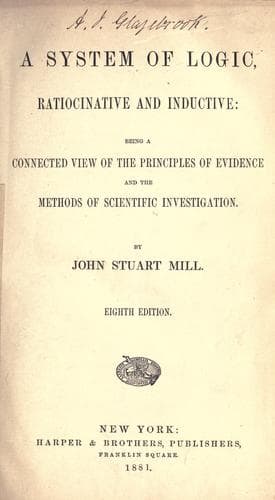
A System of Logic, Ratiocinative and InductiveMill, John Stuart
PhilosophyPhilosophy
A System of Logic, Ratiocinative and Inductive
Mill, John Stuart
Knowledge, Theory of; Logic; Science -- Methodology
To save the credit of the doctrine that definitions are the premises of
scientific knowledge, the proviso is sometimes added, that they are so
only under a certain condition, namely, that they be framed conformably to
the phenomena of nature; that is, that they ascribe such meanings to terms
as shall suit objects actually existing. But this is only an instance of
the attempt so often made, to escape from the necessity of abandoning old
language after the ideas which it expresses have been exchanged for
contrary ones. From the meaning of a name (we are told) it is possible to
infer physical facts, provided the name has corresponding to it an
existing thing. But if this proviso be necessary, from which of the two is
the inference really drawn? From the existence of a thing having the
properties, or from the existence of a name meaning them?
Take, for instance, any of the definitions laid down as premises in
Euclid’s Elements; the definition, let us say, of a circle. This, being
analyzed, consists of two propositions; the one an assumption with respect
to a matter of fact, the other a genuine definition. “A figure may exist,
having all the points in the line which bounds it equally distant from a
single point within it:” “Any figure possessing this property is called a
circle.” Let us look at one of the demonstrations which are said to depend
on this definition, and observe to which of the two propositions contained
in it the demonstration really appeals. “About the centre A, describe the
circle B C D.”
Here is an assumption that a figure, such as the definition expresses,
_may_ be described; which is no other than the postulate, or covert
assumption, involved in the so-called definition. But whether that figure
be called a circle or not is quite immaterial. The purpose would be as
well answered, in all respects except brevity, were we to say, “Through
the point B, draw a line returning into itself, of which every point shall
be at an equal distance from the point A.” By this the definition of a
circle would be got rid of, and rendered needless; but not the postulate
implied in it; without that the demonstration could not stand. The circle
being now described, let us proceed to the consequence. “Since B C D is a
circle, the radius B A is equal to the radius C A.” B A is equal to C A,
not because B C D is a circle, but because B C D is a figure with the
radii equal. Our warrant for assuming that such a figure about the centre
A, with the radius B A, may be made to exist, is the postulate. Whether
the admissibility of these postulates rests on intuition, or on proof, may
be a matter of dispute; but in either case they are the premises on which
the theorems depend; and while these are retained it would make no
difference in the certainty of geometrical truths, though every definition
in Euclid, and every technical term therein defined, were laid aside.
Public-domain text, read in full here on John Shaqi.
Reviews
Reviews
No reviews yet
Be the first to share your thoughts on this work.
Elsewhere in the archive
Join the Discussion
Join the discussion
Sign in to leave a comment or review.
Sign InorCreate an account