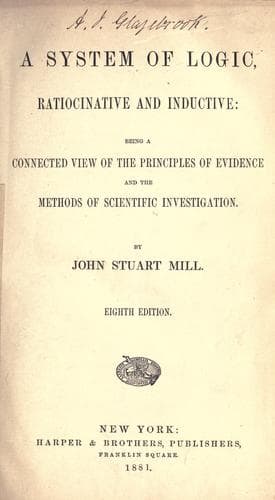
A System of Logic, Ratiocinative and InductiveMill, John Stuart
PhilosophyPhilosophy
A System of Logic, Ratiocinative and Inductive
Mill, John Stuart
Knowledge, Theory of; Logic; Science -- Methodology
It is, perhaps, superfluous to dwell at so much length on what is so
nearly self-evident; but when a distinction, obvious as it may appear, has
been confounded, and by powerful intellects, it is better to say too much
than too little for the purpose of rendering such mistakes impossible in
future. I will, therefore detain the reader while I point out one of the
absurd consequences flowing from the supposition that definitions, as
such, are the premises in any of our reasonings, except such as relate to
words only. If this supposition were true, we might argue correctly from
true premises, and arrive at a false conclusion. We should only have to
assume as a premise the definition of a nonentity; or rather of a name
which has no entity corresponding to it. Let this, for instance, be our
definition:
A dragon is a serpent breathing flame.
This proposition, considered only as a definition, is indisputably
correct. A dragon _is_ a serpent breathing flame: the word _means_ that.
The tacit assumption, indeed (if there were any such understood
assertion), of the existence of an object with properties corresponding to
the definition, would, in the present instance, be false. Out of this
definition we may carve the premises of the following syllogism:
A dragon is a thing which breathes flame:
A dragon is a serpent:
From which the conclusion is,
Therefore some serpent or serpents breathe flame:
an unexceptionable syllogism in the first mode of the third figure, in
which both premises are true and yet the conclusion false; which every
logician knows to be an absurdity. The conclusion being false and the
syllogism correct, the premises can not be true. But the premises,
considered as parts of a definition, are true. Therefore, the premises
considered as parts of a definition can not be the real ones. The real
premises must be—
A dragon is a _really existing_ thing which breathes flame:
A dragon is a _really existing_ serpent:
which implied premises being false, the falsity of the conclusion presents
no absurdity.
If we would determine what conclusion follows from the same ostensible
premises when the tacit assumption of real existence is left out, let us,
according to the recommendation in a previous page, substitute _means_ for
_is_. We then have—
Dragon is _a word meaning_ a thing which breathes flame:
Dragon is _a word meaning_ a serpent:
From which the conclusion is,
Some _word or words which mean_ a serpent, also mean a thing which
breathes flame:
where the conclusion (as well as the premises) is true, and is the only
kind of conclusion which can ever follow from a definition, namely, a
proposition relating to the meaning of words.
There is still another shape into which we may transform this syllogism.
We may suppose the middle term to be the designation neither of a thing
nor of a name, but of an idea. We then have—
Public-domain text, read in full here on John Shaqi.
Reviews
Reviews
No reviews yet
Be the first to share your thoughts on this work.
Elsewhere in the archive
Join the Discussion
Join the discussion
Sign in to leave a comment or review.
Sign InorCreate an account