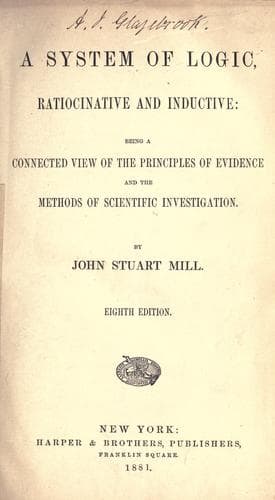
A System of Logic, Ratiocinative and InductiveMill, John Stuart
PhilosophyPhilosophy
A System of Logic, Ratiocinative and Inductive
Mill, John Stuart
Knowledge, Theory of; Logic; Science -- Methodology
The _idea of_ a dragon is _an idea of_ a thing which breathes
flame:
The _idea of_ a dragon is _an idea of_ a serpent:
Therefore, there is _an idea of_ a serpent, which is _an idea of_
a thing breathing flame.
Here the conclusion is true, and also the premises; but the premises are
not definitions. They are propositions affirming that an idea existing in
the mind, includes certain ideal elements. The truth of the conclusion
follows from the existence of the psychological phenomenon called the idea
of a dragon; and therefore still from the tacit assumption of a matter of
fact.(45)
When, as in this last syllogism, the conclusion is a proposition
respecting an idea, the assumption on which it depends may be merely that
of the existence of an idea. But when the conclusion is a proposition
concerning a Thing, the postulate involved in the definition which stands
as the apparent premise, is the existence of a thing conformable to the
definition, and not merely of an idea conformable to it. This assumption
of real existence we always convey the impression that we intend to make,
when we profess to define any name which is already known to be a name of
really existing objects. On this account it is, that the assumption was
not necessarily implied in the definition of a dragon, while there was no
doubt of its being included in the definition of a circle.
§ 6. One of the circumstances which have contributed to keep up the
notion, that demonstrative truths follow from definitions rather than from
the postulates implied in those definitions, is, that the postulates, even
in those sciences which are considered to surpass all others in
demonstrative certainty, are not always exactly true. It is not true that
a circle exists, or can be described, which has all its radii _exactly_
equal. Such accuracy is ideal only; it is not found in nature, still less
can it be realized by art. People had a difficulty, therefore, in
conceiving that the most certain of all conclusions could rest on premises
which, instead of being certainly true, are certainly not true to the full
extent asserted. This apparent paradox will be examined when we come to
treat of Demonstration; where we shall be able to show that as much of the
postulate is true, as is required to support as much as is true of the
conclusion. Philosophers, however, to whom this view had not occurred, or
whom it did not satisfy, have thought it indispensable that there should
be found in definitions something _more_ certain, or at least more
accurately true, than the implied postulate of the real existence of a
corresponding object. And this something they flattered themselves they
had found, when they laid it down that a definition is a statement and
analysis not of the mere meaning of a word, nor yet of the nature of a
thing, but of an idea. Thus, the proposition, “A circle is a plane figure
Public-domain text, read in full here on John Shaqi.
Reviews
Reviews
No reviews yet
Be the first to share your thoughts on this work.
Elsewhere in the archive
Join the Discussion
Join the discussion
Sign in to leave a comment or review.
Sign InorCreate an account