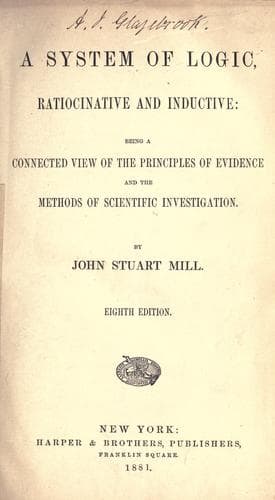
A System of Logic, Ratiocinative and InductiveMill, John Stuart
PhilosophyPhilosophy
A System of Logic, Ratiocinative and Inductive
Mill, John Stuart
Knowledge, Theory of; Logic; Science -- Methodology
bounded by a line all the points of which are at an equal distance from a
given point within it,” was considered by them, not as an assertion that
any real circle has that property (which would not be exactly true), but
that we _conceive_ a circle as having it; that our abstract idea of a
circle is an idea of a figure with its radii exactly equal.
Conformably to this it is said, that the subject-matter of mathematics,
and of every other demonstrative science, is not things as they really
exist, but abstractions of the mind. A geometrical line is a line without
breadth; but no such line exists in nature; it is a notion merely
suggested to the mind by its experience of nature. The definition (it is
said) is a definition of this mental line, not of any actual line: and it
is only of the mental line, not of any line existing in nature, that the
theorems of geometry are accurately true.
Allowing this doctrine respecting the nature of demonstrative truth to be
correct (which, in a subsequent place, I shall endeavor to prove that it
is not); even on that supposition, the conclusions which seem to follow
from a definition, do not follow from the definition as such, but from an
implied postulate. Even if it be true that there is no object in nature
answering to the definition of a line, and that the geometrical properties
of lines are not true of any lines in nature, but only of the idea of a
line; the definition, at all events, postulates the real existence of such
an idea: it assumes that the mind can frame, or rather has framed, the
notion of length without breadth, and without any other sensible property
whatever. To me, indeed, it appears that the mind can not form any such
notion; it can not conceive length without breadth; it can only, in
contemplating objects, attend to their length, exclusively of their other
sensible qualities, and so determine what properties may be predicated of
them in virtue of their length alone. If this be true, the postulate
involved in the geometrical definition of a line, is the real existence,
not of length without breadth, but merely of length, that is, of long
objects. This is quite enough to support all the truths of geometry, since
every property of a geometrical line is really a property of all physical
objects in so far as possessing length. But even what I hold to be the
false doctrine on the subject, leaves the conclusion that our reasonings
are grounded on the matters of fact postulated in definitions, and not on
the definitions themselves, entirely unaffected; and accordingly this
conclusion is one which I have in common with Dr. Whewell, in his
_Philosophy of the Inductive Sciences_: though, on the nature of
demonstrative truth, Dr. Whewell’s opinions are greatly at variance with
mine. And here, as in many other instances, I gladly acknowledge that his
writings are eminently serviceable in clearing from confusion the initial
steps in the analysis of the mental processes, even where his views
Public-domain text, read in full here on John Shaqi.
Reviews
Reviews
No reviews yet
Be the first to share your thoughts on this work.
Elsewhere in the archive
Join the Discussion
Join the discussion
Sign in to leave a comment or review.
Sign InorCreate an account