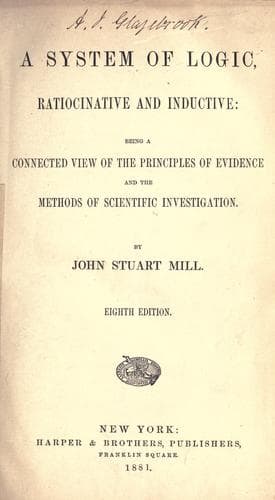
A System of Logic, Ratiocinative and InductiveMill, John Stuart
PhilosophyPhilosophy
A System of Logic, Ratiocinative and Inductive
Mill, John Stuart
Knowledge, Theory of; Logic; Science -- Methodology
respecting the ultimate analysis are such as (though with unfeigned
respect) I can not but regard as fundamentally erroneous.
§ 7. Although, according to the opinion here presented, Definitions are
properly of names only, and not of things, it does not follow from this
that definitions are arbitrary. How to define a name, may not only be an
inquiry of considerable difficulty and intricacy, but may involve
considerations going deep into the nature of the things which are denoted
by the name. Such, for instance, are the inquiries which form the subjects
of the most important of Plato’s Dialogues; as, “What is rhetoric?” the
topic of the Gorgias, or, “What is justice?” that of the Republic. Such,
also, is the question scornfully asked by Pilate, “What is truth?” and the
fundamental question with speculative moralists in all ages, “What is
virtue?”
It would be a mistake to represent these difficult and noble inquiries as
having nothing in view beyond ascertaining the conventional meaning of a
name. They are inquiries not so much to determine what is, as what should
be, the meaning of a name; which, like other practical questions of
terminology, requires for its solution that we should enter, and sometimes
enter very deeply, into the properties not merely of names but of the
things named.
Although the meaning of every concrete general name resides in the
attributes which it connotes, the objects were named before the
attributes; as appears from the fact that in all languages, abstract names
are mostly compounds or other derivatives of the concrete names which
correspond to them. Connotative names, therefore, were, after proper
names, the first which were used: and in the simpler cases, no doubt, a
distinct connotation was present to the minds of those who first used the
name, and was distinctly intended by them to be conveyed by it. The first
person who used the word white, as applied to snow or to any other object,
knew, no doubt, very well what quality he intended to predicate, and had a
perfectly distinct conception in his mind of the attribute signified by
the name.
Public-domain text, read in full here on John Shaqi.
Reviews
Reviews
No reviews yet
Be the first to share your thoughts on this work.
Elsewhere in the archive
Join the Discussion
Join the discussion
Sign in to leave a comment or review.
Sign InorCreate an account