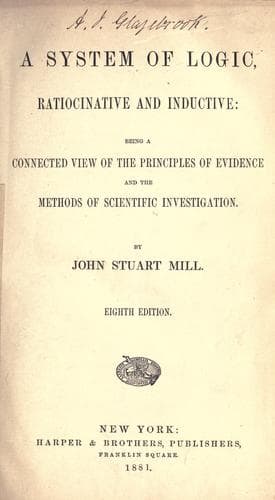
A System of Logic, Ratiocinative and Inductive — John Shaqi
A System of Logic, Ratiocinative and InductiveMill, John Stuart
PhilosophyPhilosophy
A System of Logic, Ratiocinative and Inductive
Mill, John Stuart
Knowledge, Theory of; Logic; Science -- Methodology
§ 7. Logic, then, is the science of the operations of the understanding
which are subservient to the estimation of evidence: both the process
itself of advancing from known truths to unknown, and all other
intellectual operations in so far as auxiliary to this. It includes,
therefore, the operation of Naming; for language is an instrument of
thought, as well as a means of communicating our thoughts. It includes,
also, Definition, and Classification. For, the use of these operations
(putting all other minds than one’s own out of consideration) is to serve
not only for keeping our evidences and the conclusions from them permanent
and readily accessible in the memory, but for so marshaling the facts
which we may at any time be engaged in investigating, as to enable us to
perceive more clearly what evidence there is, and to judge with fewer
chances of error whether it be sufficient. These, therefore, are
operations specially instrumental to the estimation of evidence, and, as
such, are within the province of Logic. There are other more elementary
processes, concerned in all thinking, such as Conception, Memory, and the
like; but of these it is not necessary that Logic should take any peculiar
cognizance, since they have no special connection with the problem of
Evidence, further than that, like all other problems addressed to the
understanding, it presupposes them.
Our object, then, will be, to attempt a correct analysis of the
intellectual process called Reasoning or Inference, and of such other
mental operations as are intended to facilitate this: as well as, on the
foundation of this analysis, and _pari passu_ with it, to bring together
or frame a set of rules or canons for testing the sufficiency of any given
evidence to prove any given proposition.
With respect to the first part of this undertaking, I do not attempt to
decompose the mental operations in question into their ultimate elements.
It is enough if the analysis as far as it goes is correct, and if it goes
far enough for the practical purposes of logic considered as an art. The
separation of a complicated phenomenon into its component parts is not
like a connected and interdependent chain of proof. If one link of an
argument breaks, the whole drops to the ground; but one step toward an
analysis holds good and has an independent value, though we should never
be able to make a second. The results which have been obtained by
analytical chemistry are not the less valuable, though it should be
discovered that all which we now call simple substances are really
compounds. All other things are at any rate compounded of those elements:
whether the elements themselves admit of decomposition, is an important
inquiry, but does not affect the certainty of the science up to that
point.
Public-domain text, read in full here on John Shaqi.
Reviews
Reviews
No reviews yet
Be the first to share your thoughts on this work.
Join the Discussion
Join the discussion
Sign in to leave a comment or review.
Sign InorCreate an account