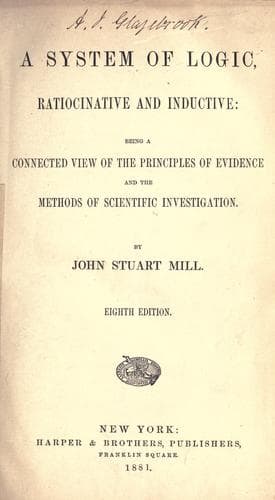
A System of Logic, Ratiocinative and InductiveMill, John Stuart
PhilosophyPhilosophy
A System of Logic, Ratiocinative and Inductive
Mill, John Stuart
Knowledge, Theory of; Logic; Science -- Methodology
I shall, accordingly, attempt to analyze the process of inference, and the
processes subordinate to inference, so far only as may be requisite for
ascertaining the difference between a correct and an incorrect performance
of those processes. The reason for thus limiting our design, is evident.
It has been said by objectors to logic, that we do not learn to use our
muscles by studying their anatomy. The fact is not quite fairly stated;
for if the action of any of our muscles were vitiated by local weakness,
or other physical defect, a knowledge of their anatomy might be very
necessary for effecting a cure. But we should be justly liable to the
criticism involved in this objection, were we, in a treatise on logic, to
carry the analysis of the reasoning process beyond the point at which any
inaccuracy which may have crept into it must become visible. In learning
bodily exercises (to carry on the same illustration) we do, and must,
analyze the bodily motions so far as is necessary for distinguishing those
which ought to be performed from those which ought not. To a similar
extent, and no further, it is necessary that the logician should analyze
the mental processes with which Logic is concerned. Logic has no interest
in carrying the analysis beyond the point at which it becomes apparent
whether the operations have in any individual case been rightly or wrongly
performed: in the same manner as the science of music teaches us to
discriminate between musical notes, and to know the combinations of which
they are susceptible, but not what number of vibrations in a second
correspond to each; which, though useful to be known, is useful for
totally different purposes. The extension of Logic as a Science is
determined by its necessities as an Art: whatever it does not need for its
practical ends, it leaves to the larger science which may be said to
correspond, not to any particular art, but to art in general; the science
which deals with the constitution of the human faculties; and to which, in
the part of our mental nature which concerns Logic, as well as in all
other parts, it belongs to decide what are ultimate facts, and what are
resolvable into other facts. And I believe it will be found that most of
the conclusions arrived at in this work have no necessary connection with
any particular views respecting the ulterior analysis. Logic is common
ground on which the partisans of Hartley and of Reid, of Locke and of
Kant, may meet and join hands. Particular and detached opinions of all
these thinkers will no doubt occasionally be controverted, since all of
them were logicians as well as metaphysicians; but the field on which
their principal battles have been fought, lies beyond the boundaries of
our science.
Public-domain text, read in full here on John Shaqi.
Reviews
Reviews
No reviews yet
Be the first to share your thoughts on this work.
Join the Discussion
Join the discussion
Sign in to leave a comment or review.
Sign InorCreate an account