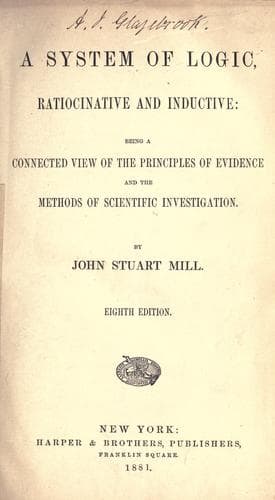
A System of Logic, Ratiocinative and InductiveMill, John Stuart
PhilosophyPhilosophy
A System of Logic, Ratiocinative and Inductive
Mill, John Stuart
Knowledge, Theory of; Logic; Science -- Methodology
Though all ratiocination admits of being thrown into one or the other of
these forms, and sometimes gains considerably by the transformation, both
in clearness and in the obviousness of its consequence; there are, no
doubt, cases in which the argument falls more naturally into one of the
other three figures, and in which its conclusiveness is more apparent at
the first glance in those figures, than when reduced to the first. Thus,
if the proposition were that pagans may be virtuous, and the evidence to
prove it were the example of Aristides; a syllogism in the third figure,
Aristides was virtuous,
Aristides was a pagan,
therefore
Some pagan was virtuous,
would be a more natural mode of stating the argument, and would carry
conviction more instantly home, than the same ratiocination strained into
the first figure, thus—
Aristides was virtuous,
Some pagan was Aristides,
therefore
Some pagan was virtuous.
A German philosopher, Lambert, whose _Neues Organon_ (published in the
year 1764) contains among other things one of the most elaborate and
complete expositions which had ever been made of the syllogistic doctrine,
has expressly examined what sort of arguments fall most naturally and
suitably into each of the four figures; and his investigation is
characterized by great ingenuity and clearness of thought.(51) The
argument, however, is one and the same, in whichever figure it is
expressed; since, as we have already seen, the premises of a syllogism in
the second, third, or fourth figure, and those of the syllogism in the
first figure to which it may be reduced, are the same premises in every
thing except language, or, at least, as much of them as contributes to the
proof of the conclusion is the same. We are therefore at liberty, in
conformity with the general opinion of logicians, to consider the two
elementary forms of the first figure as the universal types of all correct
ratiocination; the one, when the conclusion to be proved is affirmative,
the other, when it is negative; even though certain arguments may have a
tendency to clothe themselves in the forms of the second, third, and
fourth figures; which, however, can not possibly happen with the only
class of arguments which are of first-rate scientific importance, those in
which the conclusion is a universal affirmative, such conclusions being
susceptible of proof in the first figure alone.(52)
§ 2. On examining, then, these two general formulæ, we find that in both
of them, one premise, the major, is a universal proposition; and according
as this is affirmative or negative, the conclusion is so too. All
ratiocination, therefore, starts from a _general_ proposition, principle,
or assumption: a proposition in which a predicate is affirmed or denied of
an entire class; that is, in which some attribute, or the negation of some
attribute, is asserted of an indefinite number of objects distinguished by
a common characteristic, and designated, in consequence, by a common name.
Public-domain text, read in full here on John Shaqi.
Reviews
Reviews
No reviews yet
Be the first to share your thoughts on this work.
Elsewhere in the archive
Join the Discussion
Join the discussion
Sign in to leave a comment or review.
Sign InorCreate an account