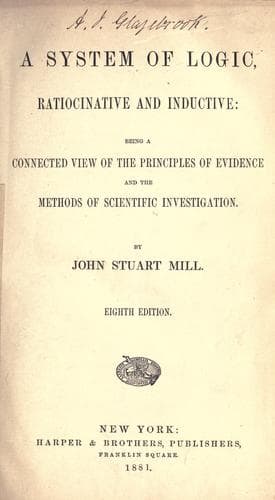
A System of Logic, Ratiocinative and InductiveMill, John Stuart
PhilosophyPhilosophy
A System of Logic, Ratiocinative and Inductive
Mill, John Stuart
Knowledge, Theory of; Logic; Science -- Methodology
Attribute A is a mark of attribute B,
The given object has the mark A,
therefore
The given object has the attribute B.
Referred to this type, the arguments which we have lately cited as
specimens of the syllogism, will express themselves in the following
manner:
The attributes of man are a mark of the attribute mortality,
Socrates has the attributes of man,
therefore
Socrates has the attribute mortality.
And again,
The attributes of man are a mark of the attribute mortality,
The attributes of a king are a mark of the attributes of man,
therefore
The attributes of a king are a mark of the attribute mortality.
And, lastly,
The attributes of man are a mark of the absence of the attribute
omnipotence,
The attributes of a king are a mark of the attributes of man,
therefore
The attributes of a king are a mark of the absence of the attribute
signified by the word omnipotent (or, are evidence of the absence of that
attribute).
To correspond with this alteration in the form of the syllogisms, the
axioms on which the syllogistic process is founded must undergo a
corresponding transformation. In this altered phraseology, both those
axioms may be brought under one general expression; namely, that whatever
has any mark, has that which it is a mark of. Or, when the minor premise
as well as the major is universal, we may state it thus: Whatever is a
mark of any mark, is a mark of that which this last is a mark of. To trace
the identity of these axioms with those previously laid down, may be left
to the intelligent reader. We shall find, as we proceed, the great
convenience of the phraseology into which we have last thrown them, and
which is better adapted than any I am acquainted with, to express with
precision and force what is aimed at, and actually accomplished, in every
case of the ascertainment of a truth by ratiocination.(55)
Chapter III.
Of The Functions And Logical Value Of The Syllogism.
§ 1. We have shown what is the real nature of the truths with which the
Syllogism is conversant, in contradistinction to the more superficial
manner in which their import is conceived in the common theory; and what
are the fundamental axioms on which its probative force or conclusiveness
depends. We have now to inquire, whether the syllogistic process, that of
reasoning from generals to particulars, is, or is not, a process of
inference; a progress from the known to the unknown: a means of coming to
a knowledge of something which we did not know before.
Public-domain text, read in full here on John Shaqi.
Reviews
Reviews
No reviews yet
Be the first to share your thoughts on this work.
Elsewhere in the archive
Join the Discussion
Join the discussion
Sign in to leave a comment or review.
Sign InorCreate an account