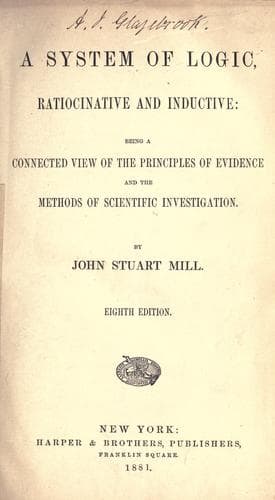
A System of Logic, Ratiocinative and InductiveMill, John Stuart
PhilosophyPhilosophy
A System of Logic, Ratiocinative and Inductive
Mill, John Stuart
Knowledge, Theory of; Logic; Science -- Methodology
Logicians have been remarkably unanimous in their mode of answering this
question. It is universally allowed that a syllogism is vicious if there
be any thing more in the conclusion than was assumed in the premises. But
this is, in fact, to say, that nothing ever was, or can be, proved by
syllogism, which was not known, or assumed to be known, before. Is
ratiocination, then, not a process of inference? And is the syllogism, to
which the word reasoning has so often been represented to be exclusively
appropriate, not really entitled to be called reasoning at all? This seems
an inevitable consequence of the doctrine, admitted by all writers on the
subject, that a syllogism can prove no more than is involved in the
premises. Yet the acknowledgment so explicitly made, has not prevented one
set of writers from continuing to represent the syllogism as the correct
analysis of what the mind actually performs in discovering and proving the
larger half of the truths, whether of science or of daily life, which we
believe; while those who have avoided this inconsistency, and followed out
the general theorem respecting the logical value of the syllogism to its
legitimate corollary, have been led to impute uselessness and frivolity to
the syllogistic theory itself, on the ground of the _petitio principii_
which they allege to be inherent in every syllogism. As I believe both
these opinions to be fundamentally erroneous, I must request the attention
of the reader to certain considerations, without which any just
appreciation of the true character of the syllogism, and the functions it
performs in philosophy, appears to me impossible; but which seem to have
been either overlooked, or insufficiently adverted to, both by the
defenders of the syllogistic theory and by its assailants.
§ 2. It must be granted that in every syllogism, considered as an argument
to prove the conclusion, there is a _petitio principii_. When we say,
All men are mortal,
Socrates is a man,
therefore
Socrates is mortal;
Public-domain text, read in full here on John Shaqi.
Reviews
Reviews
No reviews yet
Be the first to share your thoughts on this work.
Elsewhere in the archive
Join the Discussion
Join the discussion
Sign in to leave a comment or review.
Sign InorCreate an account