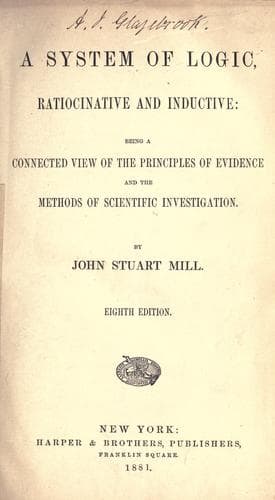
A System of Logic, Ratiocinative and InductiveMill, John Stuart
PhilosophyPhilosophy
A System of Logic, Ratiocinative and Inductive
Mill, John Stuart
Knowledge, Theory of; Logic; Science -- Methodology
The object of logic, as defined in the Introductory Chapter, is to
ascertain how we come by that portion of our knowledge (much the greatest
portion) which is not intuitive: and by what criterion we can, in matters
not self-evident, distinguish between things proved and things not proved,
between what is worthy and what is unworthy of belief. Of the various
questions which present themselves to our inquiring faculties, some
receive an answer from direct consciousness, others, if resolved at all,
can only be resolved by means of evidence. Logic is concerned with these
last. But before inquiring into the mode of resolving questions, it is
necessary to inquire what are those which offer themselves; what questions
are conceivable; what inquiries are there, to which mankind have either
obtained, or been able to imagine it possible that they should obtain, an
answer. This point is best ascertained by a survey and analysis of
Propositions.
§ 2. The answer to every question which it is possible to frame, must be
contained in a Proposition, or Assertion. Whatever can be an object of
belief, or even of disbelief, must, when put into words, assume the form
of a proposition. All truth and all error lie in propositions. What, by a
convenient misapplication of an abstract term, we call a Truth, means
simply a True Proposition; and errors are false propositions. To know the
import of all possible propositions would be to know all questions which
can be raised, all matters which are susceptible of being either believed
or disbelieved. How many kinds of inquiries can be propounded; how many
kinds of judgments can be made; and how many kinds of propositions it is
possible to frame with a meaning, are but different forms of one and the
same question. Since, then, the objects of all Belief and of all Inquiry
express themselves in propositions, a sufficient scrutiny of Propositions
and of their varieties will apprise us what questions mankind have
actually asked of themselves, and what, in the nature of answers to those
questions, they have actually thought they had grounds to believe.
Now the first glance at a proposition shows that it is formed by putting
together two names. A proposition, according to the common simple
definition, which is sufficient for our purpose is, _discourse, in which
something is affirmed or denied of something_. Thus, in the proposition,
Gold is yellow, the quality yellow is affirmed of the substance _gold_. In
the proposition, Franklin was not born in England, the fact expressed by
the words _born in England_ is denied of the man Franklin.
Public-domain text, read in full here on John Shaqi.
Reviews
Reviews
No reviews yet
Be the first to share your thoughts on this work.
Join the Discussion
Join the discussion
Sign in to leave a comment or review.
Sign InorCreate an account