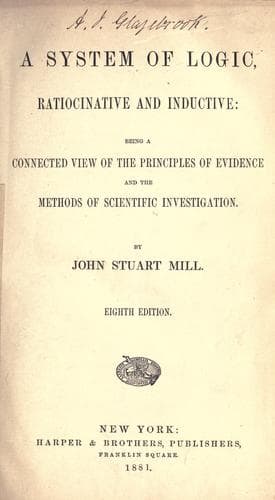
A System of Logic, Ratiocinative and InductiveMill, John Stuart
PhilosophyPhilosophy
A System of Logic, Ratiocinative and Inductive
Mill, John Stuart
Knowledge, Theory of; Logic; Science -- Methodology
Every proposition consists of three parts: the Subject, the Predicate, and
the Copula. The predicate is the name denoting that which is affirmed or
denied. The subject is the name denoting the person or thing which
something is affirmed or denied of. The copula is the sign denoting that
there is an affirmation or denial, and thereby enabling the hearer or
reader to distinguish a proposition from any other kind of discourse.
Thus, in the proposition, The earth is round, the Predicate is the word
_round_, which denotes the quality affirmed, or (as the phrase is)
predicated: _the earth_, words denoting the object which that quality is
affirmed of, compose the Subject; the word _is_, which serves as the
connecting mark between the subject and predicate, to show that one of
them is affirmed of the other, is called the Copula.
Dismissing, for the present, the copula, of which more will be said
hereafter, every proposition, then, consists of at least two names—brings
together two names, in a particular manner. This is already a first step
toward what we are in quest of. It appears from this, that for an act of
belief, _one_ object is not sufficient; the simplest act of belief
supposes, and has something to do with, _two_ objects—two names, to say
the least; and (since the names must be names of something) two _namable
things_. A large class of thinkers would cut the matter short by saying,
two _ideas_. They would say, that the subject and predicate are both of
them names of ideas; the idea of gold, for instance, and the idea of
yellow; and that what takes place (or part of what takes place) in the act
of belief consists in bringing (as it is often expressed) one of these
ideas under the other. But this we are not yet in a condition to say:
whether such be the correct mode of describing the phenomenon, is an after
consideration. The result with which for the present we must be contented,
is, that in every act of belief _two_ objects are in some manner taken
cognizance of; that there can be no belief claimed, or question
propounded, which does not embrace two distinct (either material or
intellectual) subjects of thought; each of them capable, or not, of being
conceived by itself, but incapable of being believed by itself.
Public-domain text, read in full here on John Shaqi.
Reviews
Reviews
No reviews yet
Be the first to share your thoughts on this work.
Join the Discussion
Join the discussion
Sign in to leave a comment or review.
Sign InorCreate an account